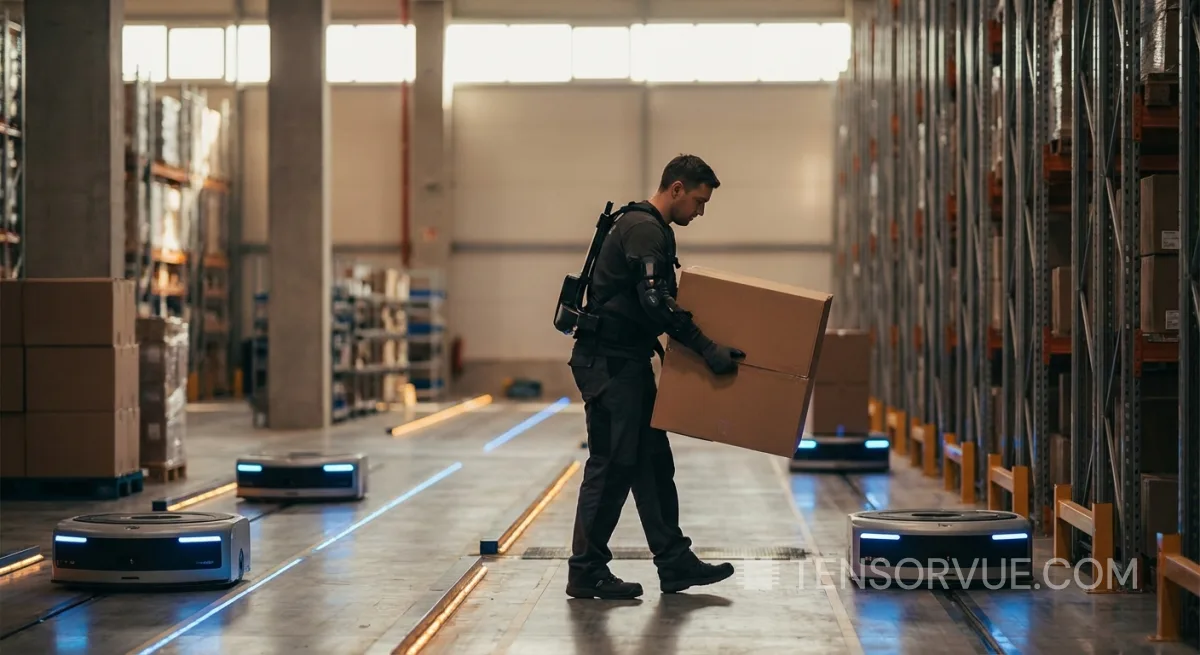
Amazon Deploys New AI-Powered Warehouse Robots and Wearable Exoskeletons for Workers
Amazon expands its warehouse automation with next-generation Robin and Cardinal sorting robots, AI-driven route optimization, and powered exoskeletons designed to reduce worker injuries by 30%.
Source: Wall Street Journal
Key Takeaways
Amazon is deploying next-generation AI-powered Robin and Cardinal robots alongside wearable exoskeletons for warehouse workers, combining autonomous sorting and handling with human augmentation to improve both speed and workplace ergonomics in fulfillment centers.
Amazon is deploying the latest generation of AI-powered robots across its fulfillment centers, paired with a new line of wearable exoskeletons designed to augment worker capabilities and reduce musculoskeletal injuries. The expansion represents Amazon's most aggressive push yet to integrate AI and robotics into its warehouse operations, which handle billions of packages annually.
Next-Generation Sorting Robots
The deployment centers on upgraded versions of Amazon's Robin and Cardinal robots — specialized systems for sorting, picking, and moving packages through fulfillment centers. The new generation incorporates enhanced computer vision and improved manipulation capabilities, allowing the robots to handle a wider variety of package sizes, shapes, and materials without human intervention.
Amazon has also expanded its AI-driven route optimization systems, which calculate the most efficient paths through warehouses in real-time. The system adapts dynamically to changing inventory positions, order volumes, and staffing levels — reducing the distance workers walk while improving order fulfillment speed.
Exoskeletons: Augmenting Human Workers
Perhaps the most worker-facing innovation is the deployment of powered exoskeletons — wearable robotic frames that assist with lifting and carrying heavy packages. Amazon reports that early trials of the exoskeletons have reduced musculoskeletal injury reports by approximately 30% in test facilities. The devices are designed to be lightweight and comfortable enough for eight-hour shifts, addressing one of the primary criticisms of Amazon's warehouse working conditions.
The Human-Robot Balance
Amazon has been careful to frame its automation strategy as human-augmenting rather than human-replacing, though the distinction is increasingly nuanced. The company employs over 1.5 million people globally and currently operates more than 750,000 robots across its facilities. Each new generation of robots handles tasks that were previously performed by humans — raising ongoing questions about long-term workforce implications even as the company continues to hire.
| Technology | Function | Key Benefit |
|---|---|---|
| Robin (Next Gen) | Package sorting and picking | Handles diverse package types without human input |
| Cardinal | Heavy package manipulation | Reduces need for manual heavy lifting |
| Route Optimization AI | Warehouse navigation | Reduces worker walking distance by 15-20% |
| Powered Exoskeletons | Worker augmentation | 30% reduction in musculoskeletal injuries |
| AI Demand Forecasting | Inventory positioning | Pre-positions inventory based on predicted orders |
For the broader logistics and retail industry, Amazon's intensifying automation investment sets an accelerating pace that competitors must match to remain competitive on delivery speed and cost — further widening the gap between technology-forward logistics operations and traditional fulfillment approaches.