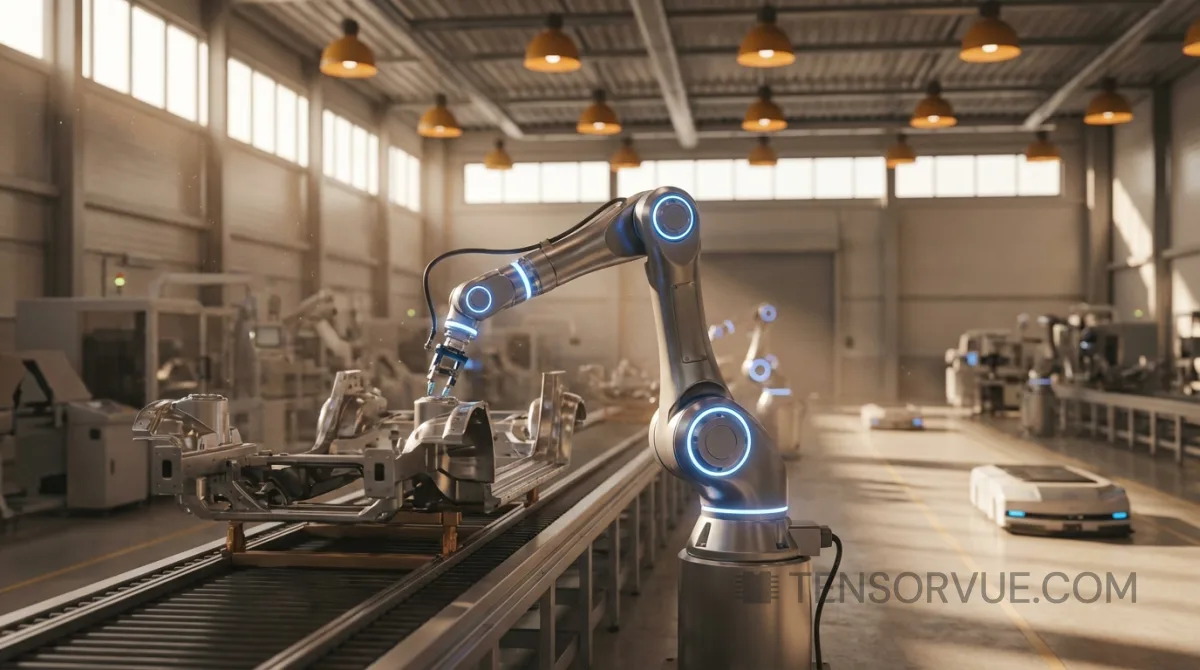
From Electric Vehicles to Factory Robots: How Rivian's RJ Scaringe Built a $2 Billion Robotics Company in Four Months
Mind Robotics, the industrial AI startup spun out of Rivian by CEO RJ Scaringe, has raised $500 million in Series A funding co-led by Accel and Andreessen Horowitz. With a $2 billion valuation and plans to deploy foundation-model-powered robots in real factories by year's end, the company is betting that the future of manufacturing lies not in humanoid novelties but in purpose-built machines that can reason, adapt, and perform the dexterous tasks that today's industrial robots cannot.
Source: The Wall Street Journal
Key Takeaways
Key takeaways: • Mind Robotics raised $500M Series A co-led by Accel and Andreessen Horowitz, reaching a $2B valuation — one of the largest Series A rounds for a robotics company in 2026 • Founded in November 2025 by Rivian CEO RJ Scaringe, the company has raised $615M total including a $115M seed from Eclipse Ventures • The startup is building a full-stack platform of foundation models, purpose-built robotics hardware, and deployment infrastructure for industrial automation • Mind Robotics leverages Rivian's manufacturing data and facilities to create a 'robotics data flywheel' — a rare competitive advantage in the capital-intensive robotics space • The company targets the 'structural gap' in manufacturing where 3.8 million positions will open by 2033 and nearly half may go unfilled, according to the Manufacturing Institute
When RJ Scaringe founded Rivian Automotive in 2009, investors dismissed the idea of a startup challenging the Detroit titans with electric pickup trucks. Seventeen years and a successful IPO later, Scaringe is making another audacious bet — this time on the factory floor itself. Mind Robotics, the industrial AI company he spun out of Rivian in November 2025, has just closed a $500 million Series A financing round co-led by Accel and Andreessen Horowitz, catapulting the four-month-old startup to a $2 billion valuation and signaling that Silicon Valley's most influential venture capital firms see the next great AI opportunity not in chatbots or autonomous cars but in the unglamorous, essential world of manufacturing.
The Thesis: Why Factory Robots Need a Brain Upgrade
The global industrial robotics market is not short on hardware. Companies like Fanuc, ABB, and KUKA have spent decades perfecting machines that can weld, paint, and palletize at superhuman speed. Yet a structural gap persists: the overwhelming majority of industrial robots operate within tightly scripted routines, repeating identical motions on identical parts in strictly controlled environments. The moment a task demands dexterity — threading a wiring harness, snapping a trim panel into place, or handling components that vary slightly from batch to batch — factories still rely on human hands.
This is precisely the gap Mind Robotics aims to close. The company is developing what it calls a "full-stack platform" consisting of three layers: foundation models trained on real-world manufacturing data, purpose-built robotic hardware designed for dexterous manipulation, and a deployment infrastructure that allows these systems to be integrated into existing production lines without wholesale factory redesigns. Rather than pursuing the attention-grabbing humanoid form factor that has attracted competitors such as Figure AI and Tesla's Optimus program, Scaringe has been emphatic that Mind Robotics will focus on task-specific, practical machines. "We are not building a general-purpose humanoid," Scaringe told investors. "We are building robots that perform real tasks, in real plants, at real scale."
The Rivian Advantage: A Data Flywheel Few Can Replicate
What distinguishes Mind Robotics from the crowded field of AI-robotics startups is its privileged relationship with Rivian. As both a major shareholder and a strategic partner, Rivian provides Mind Robotics with two assets that are extraordinarily difficult for competitors to acquire independently: a continuous stream of manufacturing data and a live production environment in which to test and deploy prototypes.
Rivian's Normal, Illinois plant — one of the largest integrated EV manufacturing facilities in North America — generates enormous volumes of sensor, quality-control, and process data daily. Mind Robotics ingests this data to train its foundation models on the physics, tolerances, and failure modes of real automotive assembly. The result is what the company describes as a "robotics data flywheel": deployed robots collect operational data that refines the models, which in turn improve the next generation of robots, creating a compounding cycle of improvement that is virtually impossible to replicate in simulation alone.
Rivian has further committed to supplying Mind Robotics with a custom processor it is developing for its autonomous-driving stack, suggesting that the two companies intend to share not only data but also silicon-level infrastructure — a degree of vertical integration unusual in the robotics industry.
The Capital Stack: From Seed to Unicorn in Record Time
The $500 million Series A is remarkable not only for its size but for the speed at which it materialized. Mind Robotics was formally incorporated in November 2025 and quickly secured a $115 million seed round led by Eclipse Ventures, a firm known for backing deep-tech industrial companies. Barely four months later, the company has now raised a total of $615 million and achieved a valuation that places it among the most highly valued robotics startups globally.
Accel partner Sameer Gandhi, who is joining Mind Robotics' board of directors, described the investment as a bet on the convergence of three trends: the maturation of large-scale foundation models, the plummeting cost of high-performance compute, and the acute labor crisis in global manufacturing. Andreessen Horowitz, which has been aggressively expanding its AI portfolio, sees Mind Robotics as a bridge between the software-centric AI paradigm it has historically backed and the physical world where, in its view, the largest economic opportunities remain untapped.
The Labor Crisis That Makes This Urgent
The timing of Mind Robotics' emergence is no accident. The manufacturing sector is staring down a demographic cliff. According to the Manufacturing Institute, 3.8 million manufacturing positions will open in the United States by 2033, and nearly half — approximately 1.9 million — are projected to go unfilled due to a shrinking pipeline of skilled workers. The median age of a U.S. manufacturing worker is now 44.3 years, and 26 percent of the current workforce is aged 55 or older, approaching retirement.
A 2026 Manufacturing Outlook Study by CADDi found that 79 percent of manufacturing leaders now identify the skilled labor shortage as their single greatest challenge — a seven-percentage-point increase from the prior year. The same survey revealed that 69 percent of companies plan to invest in physical automation assets, including robots and intelligent equipment, in 2026. The implication is clear: manufacturers are not adopting robotics as a futuristic aspiration but as an operational necessity.
The Competitive Landscape: Humanoids Versus Pragmatists
Mind Robotics enters a market that has attracted extraordinary attention and capital over the past two years. Figure AI raised $675 million at a $2.6 billion valuation in early 2024 for its humanoid robot. Tesla continues to develop Optimus for eventual deployment in its own Gigafactories. Boston Dynamics, now owned by Hyundai, recently announced a partnership with FieldAI to bring its Spot and Stretch platforms into construction and complex dynamic environments. And smaller players like Robbyant are open-sourcing vision-language-action (VLA) models such as LingBot to create what they call a "universal brain" for robots.
Scaringe's strategy deliberately diverges from the humanoid trend. Where Figure AI and Tesla are building general-purpose bipedal machines — on the theory that a human-shaped robot can operate in any environment designed for humans — Mind Robotics is designing purpose-built systems optimized for specific classes of industrial tasks. The trade-off is narrower applicability in exchange for faster deployment, higher reliability, and a more convincing near-term return on investment for factory operators. It is, in many ways, the same pragmatic bet Scaringe made with Rivian: rather than trying to build a car for everyone, he built a truck for outdoor enthusiasts and commercial fleets, and scaled from there.
Who Is RJ Scaringe?
Robert Joseph Scaringe holds a doctorate in mechanical engineering from MIT, where he focused on internal combustion engines before pivoting to electric vehicles. He founded Rivian at the age of 26 with a vision of building adventure-oriented EVs — a niche that most automotive executives considered commercially unviable. By the time Rivian went public in November 2021, it achieved a market capitalization that briefly exceeded $150 billion, making it one of the largest IPOs in American history.
Scaringe's track record as both an engineer-founder and a CEO who has navigated the brutal economics of automotive manufacturing gives him unusual credibility in the robotics space. Building a car factory from scratch — sourcing components, managing supply chains, meeting quality standards at scale — is among the hardest operational challenges in industry. Having done it once, Scaringe brings first-hand knowledge of where automation fails and where it could succeed if the technology were sufficiently advanced. It is this operational insight, combined with his MIT pedigree and his fundraising prowess, that has persuaded investors to commit more than half a billion dollars to a company with no revenue and less than five months of existence.
What Comes Next
Mind Robotics has stated that it plans to deploy its robots at scale by the end of 2026, beginning with Rivian's own production facilities before expanding to external industrial clients. The company is headquartered in Palo Alto, California, though much of its testing and deployment work is expected to take place at Rivian's Normal, Illinois plant.
Whether Mind Robotics can deliver on its ambitious timeline will depend on several factors: the generalization capability of its foundation models, the reliability of its hardware in continuous industrial operation, and the willingness of factory operators — historically conservative adopters of new technology — to trust AI-driven robots with mission-critical tasks. The company's close ties to Rivian provide a captive first customer, but scaling beyond a single factory will require proving that its robots can adapt to the diverse, unpredictable conditions of different manufacturing environments.
For now, the sheer scale of the investment — and the caliber of the investors — suggests that the smart money has concluded what Scaringe has been arguing for months: that the application of advanced AI in the physical world is, as he put it, "unimaginably large" in potential. If he is right, the dingy factory floor, not the gleaming data center, may be where the most consequential AI revolution unfolds.