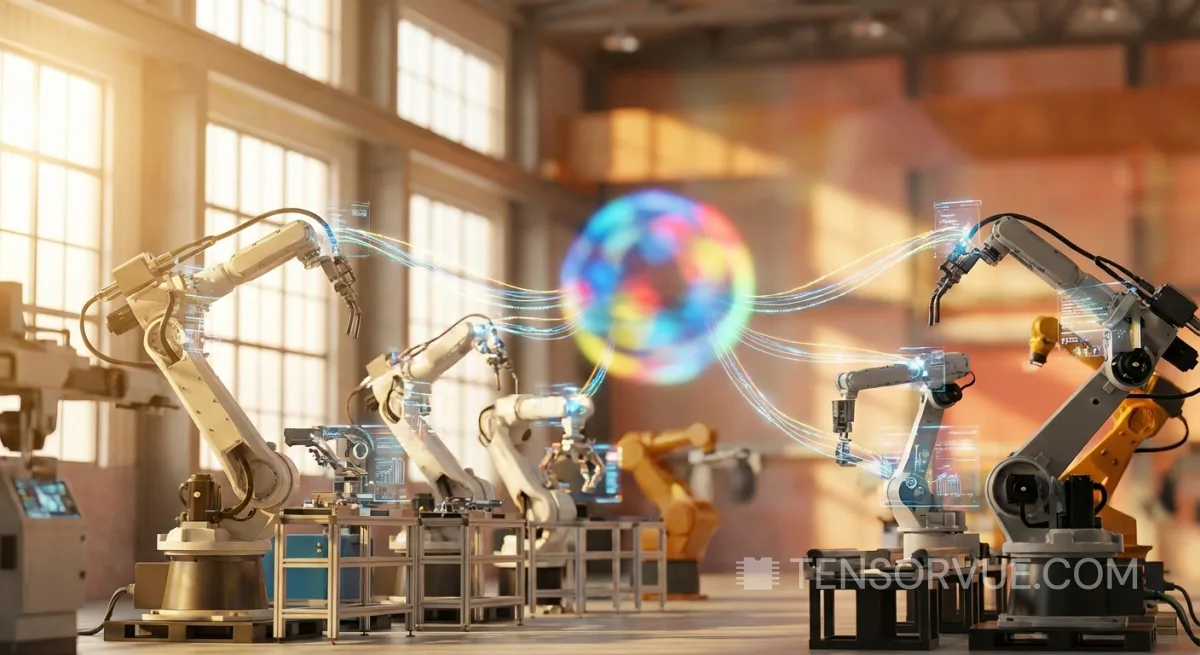
Google Absorbs Robotics Unit Intrinsic to Build the 'Android of Industrial Robots'
Google has folded Alphabet's Intrinsic robotics subsidiary back into its core operations, combining Intrinsic's industrial robot software with Gemini AI and Google Cloud to create a standardized platform aiming to become the universal operating system for factory robots.
Source: The Robot Report / WinBuzzer
Key Takeaways
Google has integrated Intrinsic — Alphabet's robotics subsidiary that spun out of Google X in 2021 — back into its core operations. The move combines Intrinsic's Flowstate industrial robotics platform with Gemini AI models and Google Cloud, targeting the creation of a universal software layer for factory robots. The strategy mirrors Android's approach: provide a standardized platform across hardware manufacturers to lower the barrier for industrial AI adoption.
Google has absorbed Intrinsic, the Alphabet subsidiary focused on industrial robotics software, back into its core operations. Announced on February 25, 2026, the integration ends Intrinsic's five-year run as a standalone Alphabet company and marks Google's most significant move into enterprise physical AI — the intersection of artificial intelligence and real-world manufacturing automation.
The strategic vision is ambitious and familiar: Google wants Intrinsic's technology to become the 'Android of robotics' — a universal software layer that works across robot hardware from any manufacturer, just as Android provides a standardized platform across hundreds of different phone makers. If successful, the approach could dramatically lower the barrier to adopting intelligent automation in factories, warehouses, and logistics facilities worldwide.
From X Lab to Alphabet to Google: Intrinsic's Journey
Intrinsic was born inside Google X, Alphabet's moonshot lab, where it spent years developing AI-powered software designed to reduce the time and expertise needed to program industrial robots. In 2021, it spun out as an independent Alphabet subsidiary — a structure that gave it autonomy but limited its access to Google's vast AI research, cloud infrastructure, and enterprise sales channels.
During its time as a standalone entity, Intrinsic made several strategic moves. It acquired Open Source Robotics Corp. (OSRC) in 2022, gaining stewardship of the widely-used Robot Operating System (ROS) — the de facto standard framework used by robotics developers worldwide. In 2023, it launched Flowstate, its commercial platform for programming and managing industrial robots through visual interfaces rather than traditional code. And in October 2025, it formed a partnership with Foxconn — Apple's primary hardware manufacturer — to develop intelligent robots for electronics manufacturing.
Why Google Wants Intrinsic Back
The reabsorption into Google unlocks three critical assets that Intrinsic could not access as a standalone subsidiary. First, Google DeepMind's Gemini AI models — particularly their multimodal capabilities for understanding visual scenes, interpreting natural language instructions, and reasoning about physical interactions. Second, Google Cloud's enterprise infrastructure, including its sales force, support organization, and global data center network. Third, Google's Tensor Processing Units (TPUs), which provide the compute needed to train and run the AI models that power intelligent robot behaviors.
Wendy Tan White will continue as Intrinsic's CEO, now reporting to Hiroshi Lockheimer — Google's chief product officer for 'Other Bets' and, notably, the executive who oversaw Android's growth into the world's most widely used mobile operating system. This reporting line is not coincidental; it reinforces the 'Android of robotics' analogy at an organizational level.
The Android Playbook Applied to Factories
The Android comparison deserves examination because it reveals Google's strategic intent. Android succeeded by solving a specific problem: phone manufacturers needed a modern operating system but lacked the resources to build one. Google provided Android for free, gained control of the mobile ecosystem, and monetized through services and advertising. The result was a platform that now runs on over 3 billion devices.
The industrial robotics market faces an analogous problem. There are hundreds of robot manufacturers worldwide — from giants like Fanuc, ABB, and KUKA to specialized niche players — but each uses proprietary software with its own programming language, interface conventions, and capabilities. This fragmentation creates enormous barriers to adoption: a company that invests in one manufacturer's robots cannot easily switch or mix vendors, and programming even simple tasks often requires specialized engineering skills.
| Factor | Android (Mobile) | Intrinsic (Robotics) |
|---|---|---|
| Problem | Fragmented mobile OS landscape | Fragmented robot software ecosystem |
| Free Software | Android OS | Flowstate platform (potential) |
| Hardware Partners | Samsung, LG, Xiaomi, etc. | Foxconn, various OEMs |
| AI Integration | Google Assistant, Gemini | Gemini vision + reasoning |
| Monetization | Play Store, ads, services | Google Cloud, enterprise SaaS |
| Open Standard | Android Open Source Project | Robot Operating System (ROS) |
If Intrinsic can provide a universal software layer that works across robot hardware manufacturers — handling perception, motion planning, task execution, and AI reasoning — it could create the same kind of platform lock-in that Android achieved in mobile. Manufacturers would benefit from reduced software development costs, while Google would gain a strategic position in industrial automation that extends its cloud and AI services into the physical world.
Competitive Landscape: Amazon, Tesla, and the Robotics Race
Google is not alone in pursuing industrial AI robotics. Amazon has deployed over 750,000 robots across its warehouse network and recently launched new AI-powered robotic systems and wearable exoskeletons for workers. Tesla's Optimus humanoid robot program is advancing toward manufacturing applications. Nvidia has created the Isaac platform for robot simulation and training. And a wave of startups — including Covariant, Figure AI, and Agility Robotics — are building intelligent robot systems for logistics and manufacturing.
Google's advantage lies in its AI breadth and cloud infrastructure. No competitor can match the combination of frontier AI models (Gemini), massive compute resources (TPU), enterprise cloud (Google Cloud), and an established open-source robotics framework (ROS) all under one roof. The Intrinsic integration is designed to make this combination greater than the sum of its parts.
Implications for Manufacturing
For the manufacturing sector, Google's move signals that the next wave of factory automation will be driven not by hardware innovation but by software intelligence. The robots themselves — arms, grippers, mobile platforms — are becoming commoditized. The value is shifting to the software that makes them useful: the AI that enables a robot to see, understand, plan, and adapt to new tasks without extensive reprogramming.
If Google succeeds in building the universal robotics platform, the barriers to smart manufacturing will drop significantly. A mid-sized factory that currently cannot afford the engineering team needed to deploy and maintain industrial robots could instead install hardware from any manufacturer and configure it through Intrinsic's visual programming tools, powered by Gemini's understanding of natural language instructions and visual scenes. The result would be the democratization of industrial automation — bringing intelligent machines to the millions of factories worldwide that currently lack them.