NVIDIA DLSS 5: How Generative AI Is Redefining Photorealism in Real-Time Gaming
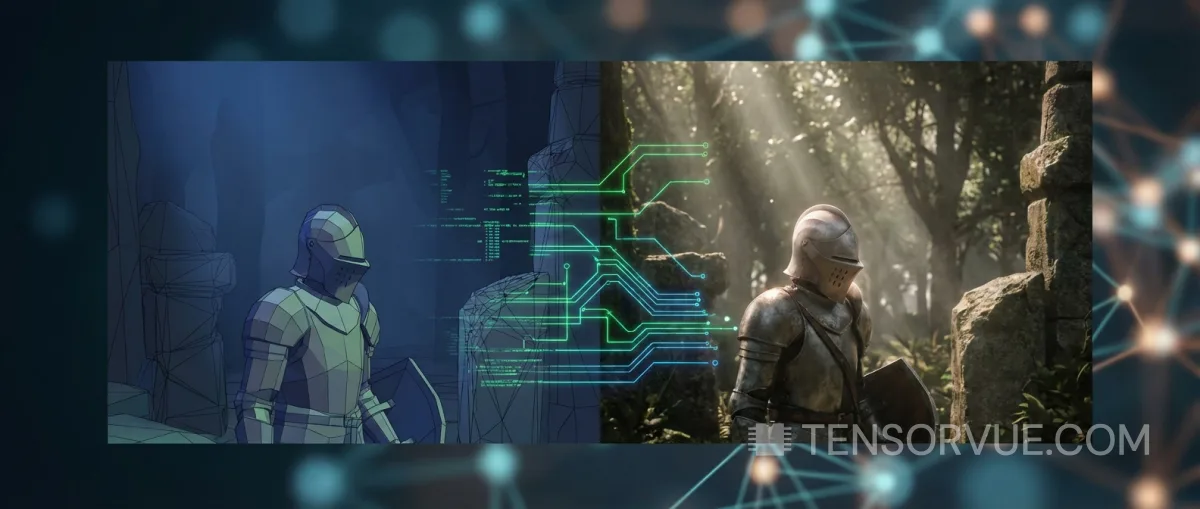
Unveiled at GTC 2026, NVIDIA's DLSS 5 represents a paradigm shift from performance-focused upscaling to AI-driven visual fidelity, deploying a real-time neural rendering model that infuses game frames with photorealistic lighting and materials — bridging the longstanding gap between interactive entertainment and Hollywood-grade visual effects.
Source: NVIDIA
Key Takeaways
Key takeaways: (1) DLSS 5 marks NVIDIA's most significant graphics breakthrough since real-time ray tracing in 2018 — shifting from performance upscaling to generative AI-driven visual fidelity enhancement. (2) The technology uses a neural rendering model trained to understand scene semantics (skin, hair, fabric, environmental lighting) from a single frame, producing photorealistic lighting and materials in real time at up to 4K. (3) Industry adoption is strong with 15+ confirmed titles from Bethesda, Capcom, Ubisoft, and Warner Bros., though the artistic control debate highlights fundamental tensions between AI augmentation and creative intent in game development.
On March 16, 2026, at the GPU Technology Conference (GTC) in San Jose, NVIDIA CEO Jensen Huang stood before a packed auditorium and made a declaration that resonated across the gaming and computer graphics industries: DLSS 5, he said, represents "the GPT moment for graphics." The comparison to the large language model that catalyzed the generative AI revolution was not made lightly. With DLSS 5, NVIDIA is fundamentally redefining what its Deep Learning Super Sampling technology does — shifting from a performance-enhancement tool that makes games run faster to a visual fidelity engine that makes games look profoundly more realistic [1].
NVIDIA characterizes this as its most significant advancement in computer graphics since the introduction of real-time ray tracing with the GeForce RTX 2080 Ti in 2018. Where previous DLSS iterations focused on upscaling lower-resolution images and generating additional frames to boost frame rates, DLSS 5 introduces a real-time neural rendering model designed to infuse every pixel with photorealistic lighting and materials — effectively bridging the gap between the visual fidelity achievable in interactive entertainment and the photorealism produced by offline rendering pipelines used in Hollywood visual effects [1][5].
The Evolutionary Arc: From Spatial Upscaling to Neural Rendering
To understand the significance of DLSS 5, it is essential to trace the technology's evolutionary trajectory. Over eight years and seven major iterations, DLSS has undergone a series of architectural transformations that mirror broader developments in deep learning research — from narrow, per-game trained networks to generalized transformer models, and now to generative AI-powered neural rendering.
DLSS 1.0, launched alongside the GeForce RTX 20 series in September 2018, employed convolutional autoencoders to upscale rendered images. Its critical limitation was the requirement for per-game training — each supported title required a bespoke neural network model trained on game-specific data. This constrained adoption to a handful of titles including Battlefield V and Metro Exodus, and image quality was inconsistent, occasionally introducing visible artifacts that undermined the technology's value proposition [4].
The transformation came with DLSS 2.0 in March 2020, which introduced a generalized temporal AI network that eliminated per-game training entirely. By incorporating motion vectors and temporal feedback from previous frames, DLSS 2.0 could reconstruct high-resolution detail that rivaled — and sometimes exceeded — native rendering quality. The shift to a universal model dramatically lowered the integration barrier for developers and established DLSS as an industry standard, with quality presets (Quality, Balanced, Performance, Ultra Performance) giving users granular control over the fidelity-performance trade-off [4].
DLSS 3.0 (October 2022) introduced the concept of Optical Multi Frame Generation alongside the GeForce RTX 40 series. Rather than merely reconstructing pixels within a single frame, DLSS 3.0 used AI to generate entirely new intermediate frames, potentially quadrupling performance over brute-force rendering. This represented a categorical expansion: DLSS was no longer just an upscaler but a frame synthesis engine, though the feature's dependency on the RTX 40 series' dedicated Optical Flow Accelerator hardware limited backward compatibility.
DLSS 3.5 (September 2023) brought Ray Reconstruction — an AI model that replaced traditional hand-tuned denoisers in the ray tracing pipeline. Trained on five times more data than DLSS 3.0, this network resolved sampled rays into higher-quality pixels, reducing ghosting artifacts and improving detail in reflections and global illumination. Crucially, Ray Reconstruction was compatible with all RTX GPUs, not just the latest generation [4].
DLSS 4.0, unveiled at CES 2025 alongside the RTX 50 series, marked the pivotal architectural shift from convolutional neural networks (CNNs) to vision transformers. The same attention-mechanism architecture that powers large language models was applied to image reconstruction, yielding substantial improvements in temporal stability, ghosting reduction, and detail preservation during motion. DLSS 4.0 also replaced the hardware-based Optical Flow Accelerator with an AI-based optical flow system running on Tensor Cores, enabling Multi Frame Generation to produce up to three additional frames per rendered frame [2][5].
DLSS 4.5, announced at CES 2026, refined this further with a second-generation transformer model and introduced 6X Dynamic Multi Frame Generation — capable of automatically adjusting the frame generation multiplier to maintain smooth frame rates, generating up to five AI-created frames for every one traditionally rendered. NVIDIA reported that DLSS 4.5's AI now draws 23 out of every 24 pixels displayed on screen [1][3][8].
| Version | Year | Key Innovation | Architecture | GPU Requirement |
|---|---|---|---|---|
| DLSS 1.0 | 2018 | Spatial upscaling (per-game training) | Convolutional autoencoder | RTX 20 series |
| DLSS 2.0 | 2020 | Generalized temporal upscaling | Convolutional neural network | All RTX GPUs |
| DLSS 3.0 | 2022 | Optical Multi Frame Generation | CNN + Optical Flow Accelerator | RTX 40 series+ |
| DLSS 3.5 | 2023 | Ray Reconstruction (AI denoising) | Enhanced CNN | All RTX GPUs |
| DLSS 4.0 | 2025 | Transformer model, AI optical flow | Vision transformer | All RTX (MFG: 50 series) |
| DLSS 4.5 | 2026 | 6X Dynamic MFG, 2nd-gen transformer | Vision transformer v2 | All RTX (MFG: 50 series) |
| DLSS 5.0 | 2026* | Real-time neural rendering | Generative AI model | RTX 50 series |
The Technical Architecture of DLSS 5: 3D-Guided Neural Rendering
DLSS 5 represents a fundamentally different technical approach from its predecessors. While DLSS 1.0 through 4.5 operated within the traditional rendering pipeline — taking rendered output and enhancing it through upscaling, frame generation, or denoising — DLSS 5 operates alongside the rendering pipeline, actively generating new visual information that the traditional pipeline cannot produce in real time.
The system's input is remarkably constrained: for each frame, DLSS 5 receives only the game engine's color buffer (the rendered image) and motion vectors (per-pixel velocity data describing object movement between frames). From these two inputs, the neural rendering model performs a sophisticated inference process. It analyzes the frame to identify semantic elements — distinguishing skin from hair, fabric from metal, translucent materials from opaque surfaces — and simultaneously evaluates environmental lighting conditions, all from analyzing a single frame [1][5][6].
Based on this semantic understanding, the model reconstructs lighting interactions with a fidelity that traditional real-time rendering engines struggle to achieve. This includes subsurface scattering on skin (where light penetrates the surface and diffuses beneath, creating the characteristic translucent glow of human skin), the complex specular behavior of hair fibers under varying illumination angles, the subtle roughness variations across fabric surfaces, and the precise way environmental light wraps around three-dimensional forms to create contact shadows and rim lighting effects [1][6].
NVIDIA draws a critical distinction between DLSS 5 and the video AI models that have proliferated in generative AI research. Contemporary video generation models — such as those powering tools like Sora or Runway — produce compelling visual output but operate offline, lack precise controllability, and generate bespoke content with each prompt. For interactive applications, these characteristics are disqualifying. Game pixels must be deterministic (the same input must produce consistent output), delivered within the 16-millisecond budget of a 60fps frame, and tightly grounded in the game developer's three-dimensional world geometry and artistic intent [1].
DLSS 5 addresses these constraints through what NVIDIA terms "3D-Guided Neural Rendering." The model's output is anchored to the source 3D content — all geometry, texture assets, and material definitions remain exactly as the game developer created them. The neural network's contribution is strictly additive: it enhances how light interacts with these existing assets, introducing photorealistic lighting behaviors that the game's rendering engine could not compute within real-time constraints. This approach maintains frame-to-frame temporal consistency, a requirement that distinguishes production-grade rendering technology from research demonstrations [1][6].
The Rendering Gap: Why Brute Force Cannot Reach Photorealism
The motivation for DLSS 5 is rooted in a fundamental asymmetry in computational budgets. A game frame at 60fps has approximately 16 milliseconds of compute time — a constraint that has driven decades of clever approximations in real-time rendering: screen-space reflections instead of true ray-traced reflections, shadow maps instead of physically accurate light transport, and baked lighting instead of dynamic global illumination.
By contrast, a single frame in a Hollywood visual effects pipeline can consume minutes to hours of render time on high-performance computing clusters. This disparity — roughly five to six orders of magnitude — means that even with the massive 375,000x increase in GPU compute that NVIDIA has delivered since the original GeForce in 1999, real-time rendering remains a tiny fraction of what is available to offline photorealistic rendering [1].
Path tracing — the physically accurate light transport simulation used in film production — addresses visual realism comprehensively but demands exponentially more compute than traditional rasterization. While NVIDIA has progressively introduced path tracing support in games (most notably with the RTX 50 series and titles like Alan Wake 2 and Cyberpunk 2077), even hardware-accelerated path tracing requires substantial computational resources and often cannot achieve full photorealism at real-time frame rates. DLSS 5 proposes a complementary approach: rather than simulating every photon, the neural rendering model has learned to predict what photorealistic lighting should look like from training on vast datasets of high-fidelity rendered imagery.
Demonstration and Initial Impressions: GTC 2026
At GTC 2026, NVIDIA demonstrated DLSS 5 across multiple game titles, with particularly striking results in Starfield, The Elder Scrolls IV: Oblivion Remastered, and Resident Evil Requiem. The demonstrations revealed several categories of enhancement [5][6].
Character rendering showed the most dramatic improvements. Facial models that previously exhibited the flat, uniform lighting characteristic of real-time rendering were transformed with complex skin shading — visible subsurface scattering created natural skin translucency, pores and fine surface detail emerged under dynamic lighting, and the subtle color shifts that occur as light passes through thin tissue (visible around the ears and nose) were accurately reproduced. Hair rendering benefited from improved specular modeling, with individual strand highlights responding naturally to changing light angles [1][5].
Environmental lighting received equally dramatic treatment. Rim lighting — the bright edge illumination that cinematographers use to separate subjects from backgrounds — appeared naturally where the scene geometry and light direction warranted it. Contact shadows (the subtle darkening where objects touch surfaces) gained depth and softness. Fabric and armor materials exhibited more convincing roughness variations and metallic reflections.
However, early hands-on assessments from outlets including Tom's Hardware noted that while the results could be impressive, there remained work to be done. The initial GTC demonstrations utilized two RTX 5090 GPUs — one for rendering the game and another dedicated to the neural rendering computation. NVIDIA has stated that the technology will be optimized to run on a single GPU by the Fall 2026 launch, with various quality presets to balance visual enhancement against performance overhead [6].
Industry Adoption: Publishers and Confirmed Titles
NVIDIA has secured support from an impressive roster of publishers and development studios. Bethesda, CAPCOM, Hotta Studio, NetEase, NCSOFT, S-GAME, Tencent, Ubisoft, and Warner Bros. Games have all committed to supporting DLSS 5. The initial confirmed title list includes 15 games spanning multiple genres and development scales [1][2].
- AION 2 (NCSOFT)
- Assassin's Creed Shadows (Ubisoft)
- Black State (Tencent)
- CINDER CITY
- Delta Force (Tencent)
- Hogwarts Legacy (Warner Bros. Games)
- Justice (NetEase)
- NARAKA: BLADEPOINT (NetEase)
- NTE: Neverness to Everness (Hotta Studio)
- Phantom Blade Zero (S-GAME)
- Resident Evil Requiem (CAPCOM)
- Sea of Remnants
- Starfield (Bethesda)
- The Elder Scrolls IV: Oblivion Remastered (Bethesda)
- Where Winds Meet
The breadth of this support is notable. It includes both Western AAA studios (Bethesda, Ubisoft, Warner Bros.) and major Asian developers (Tencent, NetEase, NCSOFT, CAPCOM), suggesting that NVIDIA has invested significant engineering resources in making DLSS 5 integration accessible across diverse engine architectures and rendering pipelines. NVIDIA has stated that DLSS 5 builds upon the same framework used by previous DLSS versions and Reflex, which should facilitate the integration process for developers already familiar with the DLSS ecosystem [2].
Note: DLSS 5.0's figure of 15 represents confirmed launch titles at announcement. Previous version counts reflect cumulative ecosystem adoption at each version's maturity, not at announcement. The technology's integration framework compatibility with existing DLSS implementations suggests rapid adoption post-launch.
The Artistic Control Debate: Enhancement vs. Alteration
The announcement of DLSS 5 has catalyzed a significant discourse within the gaming community and development industry about the relationship between AI augmentation and artistic intent. The debate crystallized around the GTC demonstrations, particularly the application of DLSS 5 to character models in titles like Resident Evil Requiem, where AI-enhanced characters appeared markedly different from their original designs — smoother skin, more defined lighting, altered visual character [7].
Critics have drawn parallels to generative AI image filters, arguing that DLSS 5's automatic application of "photorealistic" lighting standards risks imposing a homogeneous aesthetic over the diverse art styles that define individual games. Some gaming community members have characterized the effect as "AI slop" — a term borrowed from the broader discourse around AI-generated content quality — suggesting that the technology prioritizes a particular vision of photorealism over the deliberate artistic choices made by game designers [7].
Gamers are completely wrong about DLSS 5. The technology is designed to enhance what artists have created, not replace it. Every developer will have full control over how DLSS 5 affects their game.
— Jensen Huang, NVIDIA CEO, responding to community concerns (March 2026)
NVIDIA has responded to these concerns through multiple channels. Jensen Huang addressed the backlash directly, asserting that developers retain comprehensive control over DLSS 5's effects through a suite of tools including intensity sliders, color grading integration, and per-region masking capabilities that allow selective application or exclusion of neural rendering enhancements across different parts of the frame. Bethesda, for its part, confirmed that DLSS 5 implementation in Starfield would be entirely optional for players and maintained under artistic direction [7].
However, reports have indicated that some developers from studios including CAPCOM and Ubisoft were apparently unaware that NVIDIA had cited their games as supporting DLSS 5, and some voiced apprehension about the use of generative AI in their titles. This communication gap highlights a broader challenge in the relationship between hardware vendors and game studios: the technology exists in a liminal space where hardware-level features can alter the visual output of creatively authored content without the direct involvement of the original artists.
Technical Implications: The Transformer-to-Generative Progression
The progression from DLSS 4.0's vision transformers to DLSS 5's generative model mirrors a well-documented pattern in AI research. Transformers' core innovation — the self-attention mechanism that allows models to capture long-range dependencies in data — proved transformative for natural language processing before being adapted for computer vision (Vision Transformers, ViT) and image generation (diffusion models, latent diffusion). NVIDIA has followed this same trajectory within DLSS, moving from task-specific CNNs to attention-based architectures to generative models.
The technical challenge specific to DLSS 5 is the latency constraint. Modern diffusion models for image generation typically require multiple inference steps (often 20–50), each adding latency that is acceptable for offline content creation but prohibitive for real-time applications. NVIDIA has not publicly detailed the specific model architecture underpinning DLSS 5, but the ability to operate within a 16ms frame budget suggests either a heavily optimized single-step inference model, a novel architecture that bypasses traditional diffusion approaches, or dedicated hardware acceleration through the RTX 50 series' fifth-generation Tensor Cores and likely specialized Neural Shader cores.
The RTX 50 series' Blackwell architecture, which underpins DLSS 5's hardware requirement, introduces significantly enhanced Tensor Core throughput and, reportedly, dedicated silicon for neural shader operations. This hardware co-design approach — where the AI model and the silicon are designed in tandem — represents a departure from the software-centric development model of previous DLSS versions and may indicate that DLSS 5's neural rendering model requires hardware capabilities not present in earlier GPU generations.
Competitive Landscape and Market Implications
DLSS 5's pivot to visual fidelity enhancement arrives in a competitive context where NVIDIA's primary rivals — AMD with FSR (FidelityFX Super Resolution) and Intel with XeSS (Xe Super Sampling) — have been narrowing the performance gap in traditional upscaling. Blind test surveys in 2026 have shown that nearly half of PC gamers prefer DLSS 4.5 over AMD's FSR and even native rendering, but the gap is no longer as wide as it was during DLSS 2.0's dominance [9].
By redefining DLSS as a visual enhancement technology rather than solely a performance tool, NVIDIA creates a new competitive dimension where its massive investment in AI research and custom silicon design confers a structural advantage. Neither AMD nor Intel currently possesses the combination of large-scale AI training infrastructure (NVIDIA's supercomputers train DLSS models on massive datasets of high-fidelity imagery) and custom Tensor Core hardware required to replicate DLSS 5's neural rendering capabilities.
This strategic positioning also serves NVIDIA's broader narrative of the GPU as an AI compute platform. By demonstrating that generative AI can produce real-time visual improvements previously impossible through traditional rendering, NVIDIA reinforces the value proposition of GPU compute capacity — aligning the consumer gaming division's messaging with the company's dominant position in AI training and inference infrastructure.
Looking Ahead: The Model-Rendered Future
DLSS 5's Fall 2026 launch target, if met, will represent the fastest iteration cadence in the technology's history — with DLSS 4.5 announced at CES 2026 (January), deployed in March, and DLSS 5 arriving roughly six months later. This acceleration suggests that NVIDIA's AI research pipeline has matured to a point where neural rendering models can be trained, validated, and deployed alongside GPU hardware cycles [10].
The longer-term implications extend beyond gaming. NVIDIA has noted that DLSS 5's neural rendering approach is applicable to virtual production (the LED wall-based filmmaking technique used in productions like The Mandalorian), architectural visualization, and any real-time 3D application where photorealistic quality is valued. If the technology proves successful in games — the most demanding real-time rendering applications due to their latency sensitivity and user interactivity — its adoption in adjacent professional markets would follow naturally.
The more profound question that DLSS 5 poses is whether the future of real-time rendering is model-driven rather than simulation-driven. Traditional rendering engines compute visual output through explicit simulation of physical processes — light transport, material interaction, atmospheric effects. Neural rendering suggests an alternative paradigm: training AI models to predict what scenes should look like based on learned representations of real-world visual phenomena, then applying those predictions in real time. If DLSS 5 delivers on its promise, it may represent the first commercially deployed instance of a technology that fundamentally alters the rendering pipeline's architecture — from simulation engines to neural inference engines.
Whether this transition preserves the creative intent of the artists who carefully craft game worlds — or whether it introduces an AI-mediated layer that subtly homogenizes visual expression — remains the central question that DLSS 5's launch will begin to answer.
📚 Sources & References
| # | Source | Link |
|---|---|---|
| [1] | NVIDIA DLSS 5 Delivers AI-Powered Breakthrough In Visual Fidelity For Games |
|
| [2] | New DLSS 4 Games, Plus DLSS 5 Announced At GTC 2026 |
|
| [3] | GeForce @ GDC 2026: 20 New DLSS 4.5 and Path-Traced Games |
|
| [4] | NVIDIA DLSS Technology Overview |
|
| [5] | Nvidia debuts DLSS 5 for increased visual fidelity in games |
|
| [6] | First look at DLSS 5 and the future of neural rendering at GTC |
|
| [7] | Jensen Huang responds to DLSS 5 backlash |
|
| [8] | DLSS 4.5 and Multi Frame Generation 6X at CES 2026 |
|
| [9] | Nearly half of PC gamers prefer DLSS 4.5 over AMD FSR |
|
| [10] | Nvidia's next-gen DLSS may leverage AI to generate textures and characters |
|