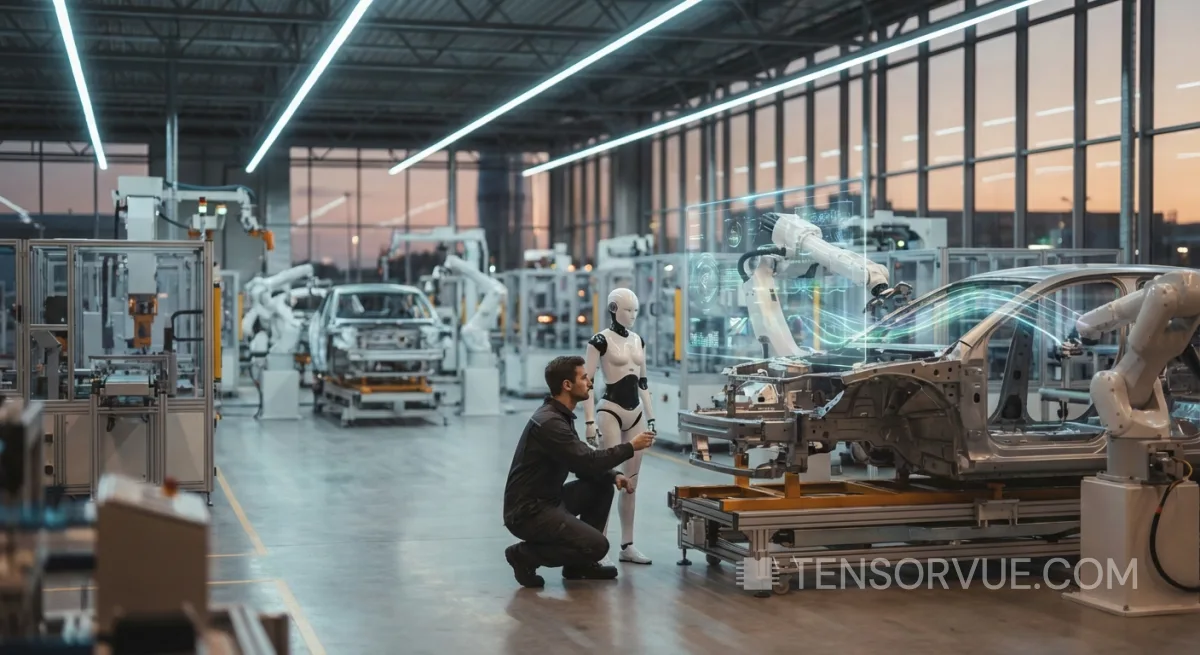
The Rise of Physical AI: How Embodied Intelligence Is Rewriting the Rules of Manufacturing
From BMW's humanoid assembly lines to NVIDIA's 99%-accurate digital twins, physical AI is no longer a lab experiment — it is becoming the defining competitive advantage of modern manufacturing. A deep analysis of the technology, economics, and strategic implications of the industry's most consequential transformation since the first industrial robot.
Source: TensorVue Analysis
Key Takeaways
Key Takeaways: • Physical AI — intelligent machines that perceive, learn, and adapt in the physical world — is moving from pilot programs to production scale across global manufacturing. • The AI-powered industrial robot market is projected to grow from $16.8 billion (2025) to $33.3 billion by 2035, driven by labor shortages, reshoring, and advances in simulation technology. • ABB and NVIDIA's RobotStudio HyperReality platform promises 99% sim-to-real accuracy, potentially cutting robot deployment costs by 40% and engineering time by 50%. • BMW, Siemens, and Foxconn are already deploying humanoid robots and AI-powered digital twins in production environments, not just testbeds. • The transition demands new workforce skills, raises questions about economic disruption, and requires careful consideration of safety and labor policy frameworks.
For decades, the word "AI" conjured images of software — large language models answering questions, recommendation engines curating feeds, algorithms trading stocks in microseconds. But a quieter, more consequential revolution has been gathering force on factory floors from Spartanburg to Shenzhen. Physical AI — artificial intelligence that inhabits robots, sensors, and machines capable of perceiving, reasoning about, and physically manipulating the real world — is crossing the threshold from promising prototype to indispensable production technology. And the companies that master it first will hold advantages that are exceptionally difficult to replicate.
The shift is not incremental. Traditional industrial robots, the fixed-path articulated arms that have welded car bodies since the 1960s, operate on pre-programmed trajectories. They are powerful but brittle: change the part geometry by a millimeter and the line stops. Physical AI systems, by contrast, fuse computer vision, reinforcement learning, tactile sensing, and real-time decision-making to handle variability — different part orientations, surface defects, unpredictable human co-workers — with a fluency that was unthinkable five years ago.
Defining Physical AI: Beyond the Buzzword
Physical AI is not simply robotics with a machine-learning layer bolted on top. It represents a fundamentally different architecture for intelligent machines. Where conventional automation follows deterministic scripts, physical AI systems construct internal world models — learned representations of physics, geometry, and material behavior — that allow them to generalize across tasks and environments they have never encountered before.
NVIDIA CEO Jensen Huang has described physical AI as 'the next frontier,' framing the company's Omniverse simulation platform and Isaac robotics stack as foundational infrastructure for this new era. The concept rests on three pillars: perception (understanding the 3D environment through cameras, lidar, and force-torque sensors), cognition (planning actions using neural-network-based world models), and dexterity (executing precise physical manipulations with adaptive control).
This architecture's power lies in its generality. A single physical AI platform can, in principle, be retrained for welding, inspection, palletizing, or delicate electronic assembly — tasks that would each require a separate, purpose-built automation cell in the traditional paradigm. For manufacturers grappling with high-mix, low-volume production runs, this flexibility is transformative.
The Market Landscape: Growth by the Numbers
The economic case for physical AI is accelerating. According to Global Market Insights, the worldwide AI-powered industrial robot market was valued at $16.8 billion in 2025 and is projected to reach $33.3 billion by 2035, growing at a compound annual growth rate (CAGR) of 7.1% [1]. North America currently holds the largest market share at $5.3 billion, but Asia-Pacific — led by China's aggressive automation push — is the fastest-growing region.
These figures track the robot hardware itself, but they understate the total economic footprint. The adjacent markets — simulation software, synthetic training data, edge AI accelerators, integration services — add billions more. The FANUC Corporation leads with approximately 8% market share, followed by ABB, Yaskawa, KUKA, and Teradyne, which collectively control about 30% of the global market [1].
The International Federation of Robotics (IFR) reported that global industrial robot installations reached 541,000 units in 2023, with annual installations exceeding 500,000 units for the third consecutive year [2]. The operational stock surpassed 4.28 million units worldwide. Looking ahead, the IFR forecasts global installations will grow 6% to approximately 575,000 units in 2025, with the 700,000-unit threshold expected by 2028. Automotive remains the largest single customer segment, but general industry — food, consumer goods, logistics — is where the fastest growth is occurring.
The Simulation Breakthrough: Closing the Sim-to-Real Gap
Physical AI's most formidable engineering challenge has always been the 'sim-to-real gap' — the difference between a robot's behavior in virtual simulation and its actual performance on the factory floor. A robot trained in a pristine digital environment often fails when confronted with real-world lighting variations, material tolerances, and thermal expansion. For years, this gap kept simulation-based training firmly in the research domain.
That barrier is now falling. In a landmark partnership announced in early 2026, ABB Robotics and NVIDIA unveiled RobotStudio HyperReality, a new product integrating NVIDIA Omniverse libraries into ABB's established RobotStudio programming and simulation suite [3]. The combined platform achieves up to 99% correlation between simulated and real-world robot behavior — a figure that, if validated at scale, represents a step change for the industry.
The technical architecture behind this achievement is instructive. RobotStudio HyperReality runs ABB's actual robot controller firmware — the identical code executing on a physical IRC5 or OmniCore controller — inside NVIDIA's physics-rich simulation environment. This means the simulation does not merely approximate the robot's kinematics; it reproduces the precise timing, trajectory interpolation, and I/O behavior of the real machine. NVIDIA's Omniverse adds GPU-accelerated physics (rigid body, soft body, fluid dynamics), ray-traced lighting for photorealistic sensor simulation, and domain-randomization tools for generating diverse synthetic training data.
| Capability | Traditional Simulation | Physical AI Digital Twin |
|---|---|---|
| Physics Fidelity | Kinematic approximation | Full rigid/soft-body, friction, thermal |
| Visual Fidelity | Simplified 3D models | Ray-traced, photorealistic |
| Controller Accuracy | Emulated behavior | Actual firmware-in-the-loop |
| Sim-to-Real Correlation | ~70–85% | Up to 99% |
| Training Data | Manual dataset creation | Automated synthetic generation |
| Deployment Cost Reduction | Minimal | Up to 40% |
| Engineering Time Savings | Marginal | Up to 50% |
The economic implications are dramatic. ABB projects that RobotStudio HyperReality can cut robot deployment costs by up to 40% and reduce engineering time by as much as 50%. For a large automotive OEM commissioning dozens of new robot cells per year, these savings translate to tens of millions of dollars and months of faster time-to-production. The software is expected to become commercially available in the second half of 2026.
Case Studies: Physical AI on the Factory Floor
BMW: Humanoids Enter European Production
BMW Group has emerged as one of the most aggressive adopters of physical AI in automotive manufacturing. At its Spartanburg plant in South Carolina, the company deployed Figure AI's Figure 02 humanoid robots in 2025. These bipedal machines worked ten-hour shifts daily alongside human operators, contributing to the production of over 30,000 BMW X3 vehicles during a ten-month trial — a scale that moved humanoid deployment well beyond the proof-of-concept stage.
In March 2026, BMW expanded the program to Europe. Its Leipzig plant began testing the AEON humanoid robot from Hexagon Robotics, marking the first deployment of physical AI in a European BMW facility. The robot's initial tasks focus on high-voltage battery assembly and precision component manufacturing for BMW's new Neue Klasse platform. A full pilot phase is scheduled for summer 2026, with the goal of evaluating multifunctional humanoid robots in general-purpose manufacturing roles — not as single-task specialists, but as flexible labor that can be reassigned between stations as production needs shift.
Foxconn: Virtual Training for Consumer Electronics Assembly
Foxconn, the world's largest electronics contract manufacturer, faces a unique physical AI challenge: the relentless cycle of new product introductions that requires retooling assembly lines multiple times per year. The company is piloting ABB's RobotStudio HyperReality in partnership with NVIDIA to virtually train its assembly robots before they ever touch a physical production line. By generating thousands of synthetic training scenarios — varying part orientations, lighting conditions, component tolerances — Foxconn can validate robot programs in simulation, compress commissioning timelines, and reduce the costly trial-and-error process that has historically accompanied each new product launch.
Siemens: Humanoids in Industrial Logistics
At Siemens' Electronics Factory in Erlangen, Germany, a different approach to physical AI is taking shape. The company partnered with UK-based Humanoid to trial human-form robots in production logistics — specifically, the repetitive task of destacking and transporting component totes between manufacturing cells. The pilot, which concluded in January 2026, achieved a throughput of 60 tote moves per hour with more than 30 minutes of sustained autonomous operation. While the numbers may seem modest, they validate the viability of humanoid robots in the cluttered, unstructured environments of real factories — spaces designed for human bodies, not specialized industrial robots.
The Five Pillars of the Physical AI Stack
Understanding where the industry is heading requires mapping the technology stack that underpins physical AI in manufacturing. Five interconnected layers are emerging as critical:
- Foundation Models for Robotics — Large-scale vision-language-action (VLA) models trained on massive datasets of robot interactions, analogous to LLMs for text. NVIDIA's GR00T and Google DeepMind's RT-2 are leading examples.
- Simulation Platforms — Physics-accurate virtual environments (Omniverse, Isaac Sim, MuJoCo) where robots can train for millions of hours in compressed time, generating diverse synthetic data without physical wear.
- Edge AI Accelerators — Low-latency, high-efficiency processors (NVIDIA Jetson, Qualcomm RB series) that run neural networks directly on the robot, enabling real-time perception and decision-making without cloud round-trips.
- Sensor Fusion Systems — Multi-modal perception stacks combining RGB cameras, depth sensors, force-torque feedback, and tactile arrays to give robots a rich understanding of their physical environment.
- Digital Twin Infrastructure — Living virtual replicas of factories that maintain real-time synchronization with their physical counterparts, enabling continuous optimization, predictive maintenance, and what-if scenario planning.
Economic Forces: Why Now?
Three macroeconomic forces are converging to make physical AI not merely attractive but strategically essential for manufacturers:
1. The Global Labor Crisis
Manufacturing labor shortages have reached structural proportions in most industrialized economies. In the United States, the National Association of Manufacturers projects that 2.1 million manufacturing positions will go unfilled by 2030. Germany faces similar demographics as its baby-boomer generation retires. Japan, with the world's oldest population, has embraced robotics as an existential necessity. China — long the world's workshop — is now the single largest installer of industrial robots, driven not by low wages but by a rapidly shrinking working-age population. Physical AI offers something traditional automation cannot: the ability to fill roles that require judgment, dexterity, and adaptability — roles that, until recently, only humans could perform.
2. The Reshoring Imperative
The COVID-19 pandemic exposed the fragility of global supply chains. Geopolitical tensions — U.S.-China technology restrictions, European energy insecurity, semiconductor bottlenecks — have amplified the urgency. Governments from Washington to Brussels are actively incentivizing domestic manufacturing through legislation like the CHIPS Act and the EU's Net Zero Industry Act. But reshoring only works economically if production costs can be controlled, and physical AI is the enabling technology that makes high-wage-country manufacturing competitive with low-cost offshore alternatives.
3. The Complexity Explosion
Modern products are becoming more complex, more customized, and more rapidly iterated. Electric vehicles have fundamentally different manufacturing requirements than internal combustion engines. Consumer electronics cycles have compressed from years to months. Medical devices demand micron-level precision with full traceability. These trends make traditional fixed-automation approaches increasingly untenable and elevate physical AI's value proposition as a flexible, rapidly reconfigurable manufacturing platform.
The Competitive Dynamics: Who Leads, Who Follows
| Player | Role | Key Physical AI Initiatives |
|---|---|---|
| NVIDIA | Platform Provider | Omniverse simulation, Isaac robotics, Cosmos foundation models, GR00T humanoid model |
| ABB | Robot OEM & Integrator | RobotStudio HyperReality (Omniverse integration), OmniCore controller platform |
| FANUC | Robot OEM (Market Leader) | Revamp of CRX collaborative line with AI-enabled vision guidance |
| BMW Group | Industrial Adopter | Figure 02 humanoid deployment (Spartanburg), Hexagon AEON trial (Leipzig) |
| Foxconn | Industrial Adopter | Virtual robot training with ABB/NVIDIA for consumer electronics assembly |
| Siemens | Industrial Conglomerate | Humanoid logistics trial (Erlangen), Simatic Robot Pick AI for bin picking |
| Figure AI | Humanoid Startup | Figure 02 bipedal robot, deployed at BMW, backed by Microsoft and NVIDIA |
| Google DeepMind | Research | RT-2 vision-language-action model for robotic manipulation |
The competitive landscape reveals a telling pattern: the companies investing most aggressively in physical AI are not startups chasing the next hype cycle — they are established industrial incumbents with decades of manufacturing expertise and billions in deployed assets. NVIDIA's strategy is particularly shrewd: rather than building robots, it is building the platform layer (Omniverse, Isaac, Cosmos) that every robot maker and integrator needs, positioning itself as the 'Intel Inside' of physical AI.
Challenges and Risks: The Road Ahead Is Not Smooth
For all its promise, physical AI in manufacturing faces formidable obstacles that temper the optimism with necessary realism.
Integration complexity remains the foremost barrier. Most factories are brownfield environments — decades-old facilities with heterogeneous equipment, legacy control systems, and deeply embedded processes. Introducing physical AI requires not just new robots but new data infrastructure, new safety frameworks, and new organizational competencies. A McKinsey analysis found that while 78% of organizations now use AI in at least one business function, only 1% consider their AI implementation to have reached maturity — a sobering indicator of the distance between pilot and production-scale deployment.
Safety certification presents another challenge. Collaborative robots operating in close proximity to human workers must meet stringent safety standards (ISO 10218, ISO/TS 15066). Humanoid robots, with their greater degrees of freedom and more complex failure modes, will require new certification frameworks that regulatory bodies are only beginning to develop. The tension between innovation speed and regulatory rigor will define the pace of deployment for years to come.
Cybersecurity is an underappreciated risk. Networked, AI-enabled manufacturing systems present an expanded attack surface. A compromised robot controller or poisoned training dataset could cause physical equipment damage, production shutdowns, or worker injuries. The convergence of IT and OT (operational technology) networks that physical AI demands must be accompanied by equally robust security architectures.
Finally, workforce displacement concerns deserve serious engagement, not dismissal. While physical AI will create new roles — robot trainers, simulation engineers, AI safety specialists — it will also render some existing manufacturing positions redundant. The transition demands proactive investment in retraining programs, updated labor policies, and honest societal dialogue about how the economic gains from AI-driven productivity are distributed.
The Outlook: From Pilot to Platform
The trajectory of physical AI in manufacturing over the next three to five years will likely follow a pattern familiar from previous waves of industrial technology: aggressive pilot programs in 2025–2026, selective production deployment in 2027–2028, and broader standardization by 2029–2030. Several inflection points bear watching.
- ABB's RobotStudio HyperReality commercial launch (H2 2026) — the first major test of whether 99% sim-to-real accuracy holds across diverse manufacturing environments.
- NVIDIA GTC 2026 announcements — expected to reveal next-generation Omniverse capabilities, updated Cosmos foundation models, and expanded partnerships with robot OEMs.
- BMW Leipzig full pilot results (summer 2026) — will determine whether humanoid robots earn permanent roles in European automotive production.
- EU AI Act enforcement timeline — as the Act's requirements for 'high-risk AI systems' take effect, manufacturers deploying physical AI in safety-critical environments will face new compliance obligations.
- China's physical AI initiatives — domestic players like UBTECH, Fourier Intelligence, and emerging VLA startups are rapidly closing the capability gap with Western counterparts.
Conclusion: Intelligence Made Tangible
Physical AI represents something more profound than the next iteration of factory automation. It is the moment when artificial intelligence, which has spent the past decade learning to understand language, images, and code, begins learning to understand and act within the physical world. For manufacturing — an industry that literally shapes the material fabric of civilization — this is a transformation of the first order.
The companies that treat physical AI as a strategic capability — investing in digital twin infrastructure, cultivating simulation expertise, and building organizational readiness — will compound advantages that are difficult for competitors to overcome. Those that wait for the technology to mature further risk finding that their competitors have already locked in the talent, partnerships, and operational knowledge that define leadership in this space.
The factory of 2030 will not merely be automated. It will be intelligent, adaptive, and continuously learning — a physical system with a digital brain. The race to build it has already begun.
📚 Sources & References
| # | Source | Link |
|---|---|---|
| [1] | AI-Powered Industrial Robot Market Size & Forecast 2026–2035 |
|
| [2] | World Robotics 2024 — Industrial Robots Report |
|
| [3] | NVIDIA Omniverse Platform for Physical AI |
|