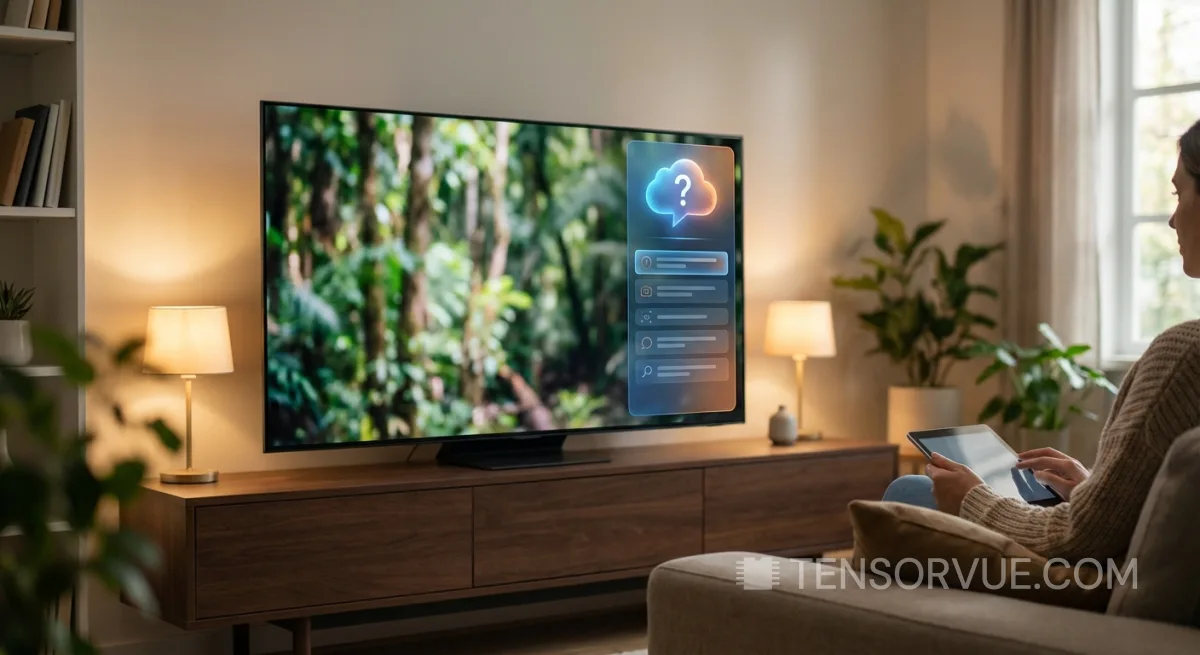
YouTube Tests Conversational AI 'Ask' Button for Smart TVs, Enabling Viewers to Query Videos Without Pausing
YouTube's expanding experiment brings an AI-powered 'Ask' button to television screens, letting viewers ask questions about what they're watching, request summaries, and get recommendations — all through their remote control.
Source: Android Headlines
Key Takeaways
YouTube is testing a conversational AI 'Ask' button for Smart TVs that lets viewers query video content without pausing playback. Users can ask questions about topics discussed in the video and receive AI-generated answers with relevant timestamps.
YouTube is expanding its experimental conversational AI feature — an 'Ask' button on the television interface — that allows viewers to interact with video content using natural language queries through their remote control. The feature, which has been in limited testing since 2024, is now rolling out to a wider set of smart TV platforms and becoming a focal point of YouTube CEO Neal Mohan's priorities for 2026.
How It Works
When watching a video, viewers can press the 'Ask' button to open a conversational interface. They can then type or speak questions about the content they're watching: 'What recipe is being shown right now?', 'Who is this person being interviewed?', 'Can you summarize the key points?' The AI analyzes the video content, transcript, and metadata to generate contextually relevant responses.
The system also proactively generates recommendations based on viewing context — suggesting related videos, playlists, or creators that match the viewer's current interest without requiring them to navigate away from their current content. This represents a significant evolution of YouTube's recommendation engine: from passive suggestion algorithms to an interactive, conversational discovery experience.
Voice Search Dominance Growing
The conversational AI feature builds on an existing trend: voice search now accounts for 35% of all YouTube searches, up from 22% in 2024. This shift toward natural language interaction is particularly pronounced on television screens, where typing with a remote control is cumbersome and voice commands offer a dramatically better user experience.
The Living Room AI Race
YouTube's initiative places it in a broader competition to make the living room television an AI-powered experience. Samsung has introduced Vision AI Companion technology in its 2026 TV models, enabling conversational interaction across entertainment and smart home management. Google TV is integrating Gemini AI for natural language queries across the operating system. LG's latest OLED models feature enhanced AI processors for content-aware optimization.
For YouTube, the stakes are particularly high: the platform has over 2 billion monthly logged-in users, and television has become its fastest-growing viewing surface. Making the TV experience more interactive through AI could significantly increase engagement time and, consequently, advertising revenue — YouTube's primary business model.