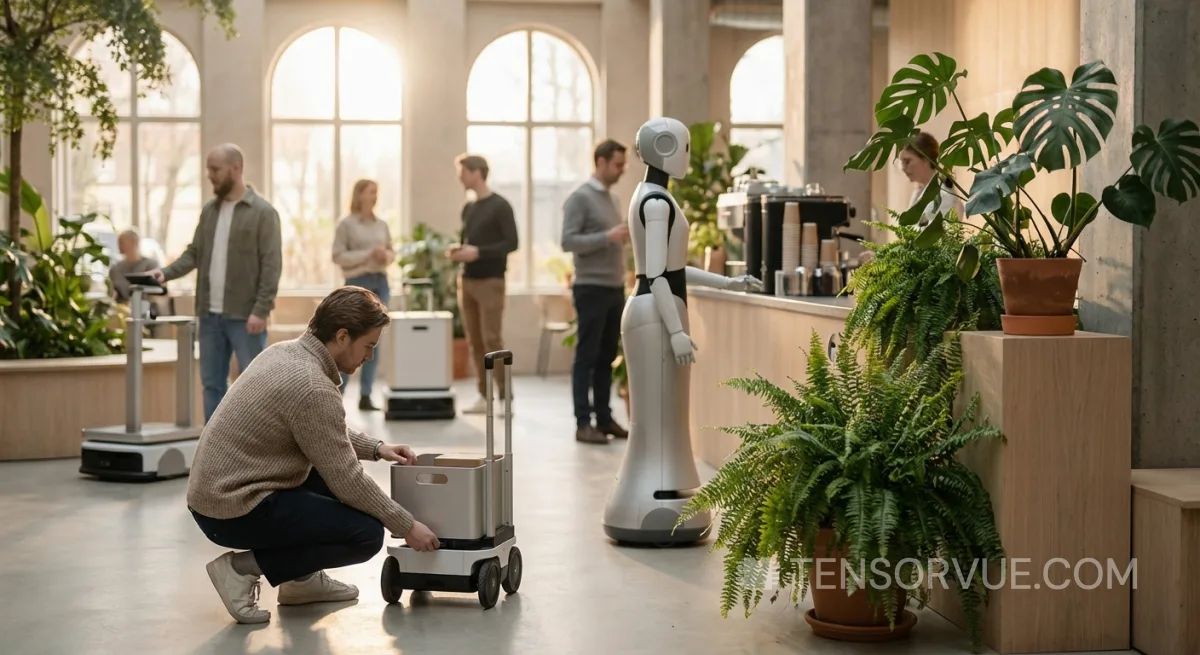
Hyundai Details AI+Robotics Roadmap for Human-Centered Autonomous Mobile Robots
Hyundai Motor Group unveils a comprehensive strategy to integrate large language models and generative AI into mobile robots, targeting leadership in human-centered robotics by 2030.
Source: Hyundai
Key Takeaways
Hyundai Motor Group has unveiled an AI+Robotics roadmap focused on human-centered autonomous mobile robots that combine natural language understanding with physical dexterity. The initiative targets manufacturing, logistics, and service applications through 2030.
Hyundai Motor Group has unveiled a comprehensive AI+Robotics roadmap, announced at CES 2026, that aims to establish the South Korean conglomerate as a global leader in human-centered robotics. The strategy integrates advanced large language models and generative AI into mobile robots designed for logistics, manufacturing, healthcare, and personal assistance applications.
LLMs Meet Physical Robots
Hyundai's approach centers on combining the natural language understanding and reasoning capabilities of large language models with the physical manipulation and navigation abilities of mobile robots. The result is robots that can understand natural language instructions, adapt to unstructured environments, and learn from demonstration rather than requiring explicit programming for every task.
The company is leveraging its 2021 acquisition of Boston Dynamics — known for its advanced quadruped (Spot) and humanoid (Atlas) robots — as the hardware foundation for its AI integration strategy. By combining Boston Dynamics' world-class mechanical engineering with Hyundai's investment in AI research, the company aims to create robots that are both physically capable and cognitively sophisticated.
Roadmap to 2030
- 2026–2027: Deploy generative AI-powered logistics robots in Hyundai's own factories and warehouses
- 2027–2028: Launch commercially available mobile robots for enterprise customers (warehousing, healthcare facilities)
- 2028–2029: Introduce personal assistance robots with advanced natural language interaction for consumer markets
- 2029–2030: Achieve fully autonomous multi-robot coordination systems operating in unstructured environments
The Competitive Landscape
Hyundai's roadmap places it in direct competition with several major players in the AI-powered robotics space. Tesla is developing its Optimus humanoid robot, Amazon has deployed over 750,000 robots in its warehouses, Samsung has announced AI-driven factory plans, and Google has made a formal entry into industrial robotics AI. The race to commercialize AI-powered mobile robots is becoming one of the most competitive segments of the broader AI industry.
What distinguishes Hyundai's approach is its emphasis on 'human-centered' design — robots that are explicitly designed to work alongside humans rather than replace them. This philosophy extends to the user interface (natural language and gesture control rather than programming consoles), safety systems (designed for shared human-robot workspaces), and deployment strategy (augmenting human capabilities rather than automating entire workflows).