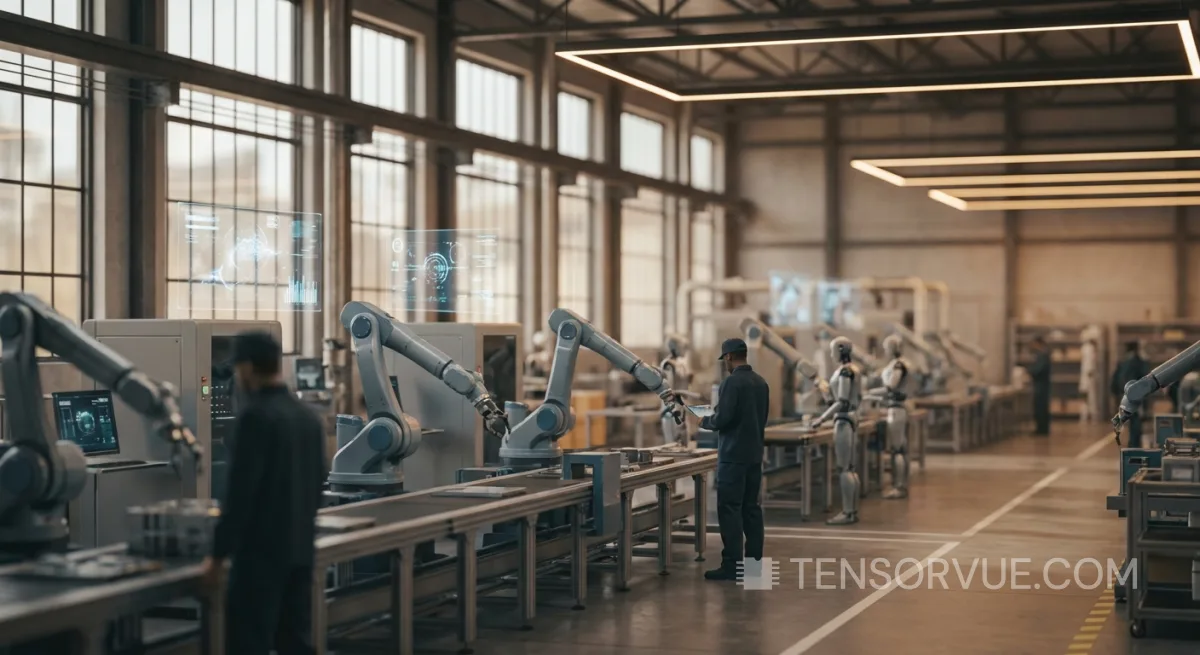
Samsung Plans AI-Controlled Robotic Factories Across All Global Operations by 2030
Samsung Electronics announces a five-year initiative to transform every manufacturing facility into an 'AI-Driven Factory,' deploying agentic AI, digital twins, and humanoid robots across its global production lines.
Source: Samsung Newsroom
Key Takeaways
Samsung has announced a five-year initiative to convert all global manufacturing operations to AI-controlled robotic factories by 2030, deploying 'agentic AI' systems capable of autonomous decision-making across production, quality control, and logistics.
Samsung Electronics has announced an ambitious five-year initiative to convert all of its global manufacturing operations into fully 'AI-Driven Factories' by 2030. The plan, unveiled at Mobile World Congress 2026, integrates artificial intelligence across the entire manufacturing value chain — from inbound material logistics through production and quality inspection to final shipment.
Agentic AI at the Factory Core
Central to Samsung's strategy is the deployment of 'agentic AI' — the same autonomous planning and execution technology the company introduced in its Galaxy S26 consumer devices. In the factory context, agentic AI systems will autonomously plan, execute, and optimize manufacturing decisions, reducing the need for human intervention in routine operational tasks.
Samsung plans to deploy specialized AI agents for three critical manufacturing functions: quality control agents that perform data-driven analysis and pre-validation to improve defect detection, production agents that optimize line efficiency and scheduling, and logistics agents that manage material flow and inventory management across facilities.
Digital Twins and Robotics
The initiative relies heavily on digital twin technology — virtual replicas of physical manufacturing processes that allow engineers to simulate changes, predict maintenance needs, and identify anomalies before they affect production. Samsung plans to implement these simulations across every stage, from material reception to shipping.
The robotics component is equally ambitious. Samsung will progressively introduce a range of robotic systems: operating robots for line management, logistics robots for material handling, assembly robots for precision manufacturing, and — notably — humanoid robots for complex and flexible operations that require adaptability beyond the capabilities of traditional industrial robots. Environmental safety robots will monitor hazardous areas and automate risk mitigation.
Industry Implications
Samsung's initiative, developed in collaboration with Nvidia for GPU-powered automation, represents one of the most comprehensive corporate AI manufacturing commitments announced to date. If successful, it could establish a new benchmark for industrial AI deployment — and intensify pressure on competitors in the semiconductor, electronics, and appliance manufacturing sectors to accelerate their own automation programs.