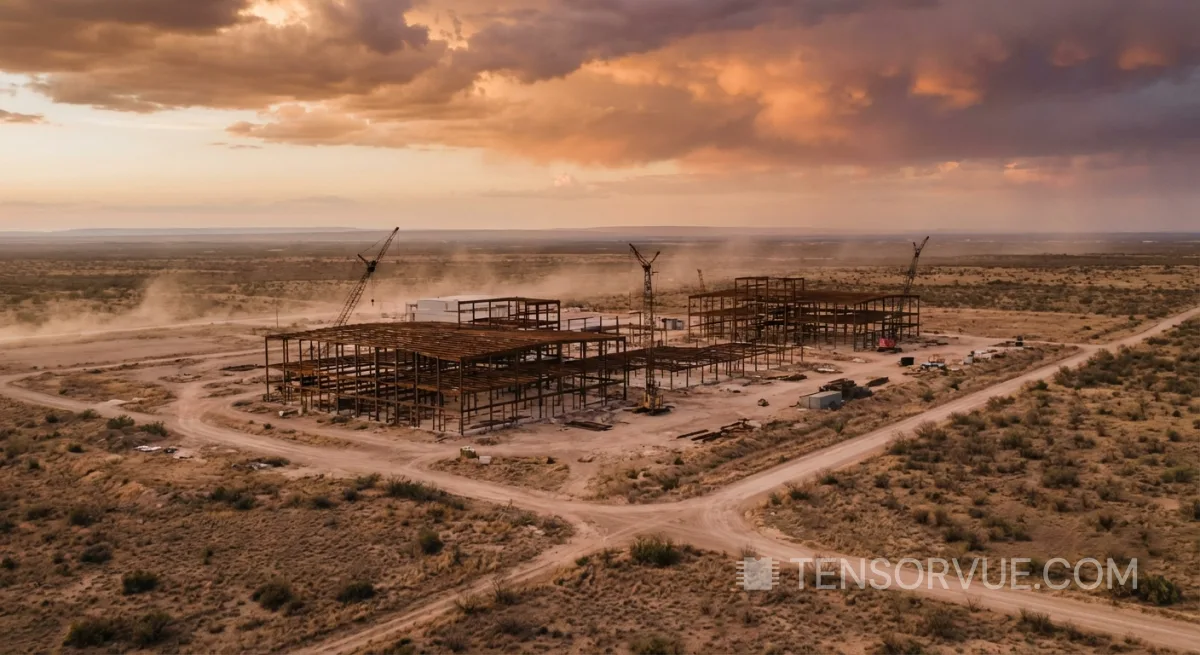
OpenAI's $500 Billion Stargate Project Hits Its First Wall as Abilene Expansion Is Canceled
Oracle and OpenAI have abandoned plans to expand the Stargate data center in Abilene, Texas from 1.2 GW to 2 GW amid stalled financing. Meta is now in talks to lease the unused capacity, while Nvidia has paid a $150 million deposit to secure GPU placement.
Source: Tom's Hardware / The Register
Key Takeaways
The Stargate project's first major setback: Oracle and OpenAI canceled the Abilene, Texas expansion from 1.2 GW to 2 GW due to stalled financing and shifting capacity needs. Meta is now negotiating to lease the excess capacity, and Nvidia has secured GPU placement with a $150M deposit. The broader $500 billion, 4.5 GW initiative continues, but the cancellation signals that even the largest AI infrastructure projects face real financial constraints.
The most ambitious data center project in history has encountered its first significant obstacle. Oracle and OpenAI have canceled plans to expand the Stargate facility in Abilene, Texas, from its current 1.2 gigawatt capacity to approximately 2 gigawatts, according to multiple reports published in early March 2026. The cancellation, attributed to stalled financing negotiations and OpenAI's evolving capacity requirements, marks the first concrete setback for a project that has been presented as the cornerstone of America's AI infrastructure future.
The Stargate initiative, announced in January 2025 as a joint venture between OpenAI, SoftBank, and Oracle, set out to invest up to $500 billion in AI data center infrastructure across the United States by 2029. The project envisions a total of 4.5 gigawatts of computing capacity spread across multiple sites — enough power to sustain a city of over three million people — dedicated entirely to training and deploying artificial intelligence systems.
What Went Wrong in Abilene
The Abilene facility, being developed by Crusoe Energy Systems, was intended to be Stargate's flagship site. The original 1.2 gigawatt build remains under construction and is expected to come online as planned. But the expansion to 2 gigawatts — which would have required additional power infrastructure, cooling systems, and facility construction — proved financially unworkable under the terms being negotiated.
Several factors contributed to the decision. Power costs in West Texas, while traditionally low, have been rising as competition for grid capacity intensifies. Multiple hyperscalers including Amazon, Google, and Microsoft are all building or planning data centers in the state, putting pressure on power generation and transmission infrastructure. The additional 800 megawatts of demand would have required new power plant construction or long-term power purchase agreements that neither Oracle nor OpenAI were willing to commit to at current prices.
OpenAI's 'evolving capacity requirements' — a euphemism that appeared in multiple reports — may also reflect a more fundamental reassessment. As AI model training techniques become more efficient, the raw compute needed to train frontier models is growing more slowly than initially projected. OpenAI's own research on algorithmic efficiency has reportedly reduced the compute budget for GPT-5.4 training by 40% compared to initial estimates.
Meta Steps In: Leasing the Excess Capacity
In a twist that underscores the fluid nature of AI infrastructure deals, Meta Platforms is reportedly in discussions to lease the additional capacity at the Abilene site that was originally earmarked for Stargate's expansion. The social media giant, which has been on an aggressive AI infrastructure spending spree, sees the partially developed facility as an opportunity to accelerate its own data center buildout without the delays of greenfield construction.
Nvidia has reportedly paid a $150 million deposit to secure the placement of its GPUs at the Abilene site — a move that ensures the chip maker's hardware will be deployed regardless of which company ultimately operates the facility. This deposit reflects the unusual dynamics of the current AI infrastructure market, where GPU manufacturers have as much interest in data center deployment as the companies that operate them.
The Broader Stargate Program Continues
OpenAI and its partners have insisted that the broader Stargate initiative remains on track. The project announced several additional data center sites in September 2025, bringing total planned capacity to nearly 7 gigawatts across multiple locations, with aggregate investment commitments exceeding $400 billion. The Abilene cancellation reduces this by approximately 0.8 gigawatts — significant in absolute terms but a relatively small percentage of the total program.
However, the cancellation raises questions about the financial viability of the grander vision. Stargate was conceived during a period of seemingly limitless enthusiasm for AI infrastructure spending. Since then, the market has become more sober about timelines and returns, driven by concerns about the gap between massive upfront investment and uncertain downstream revenue.
Industry Implications: Peak AI Infrastructure Spending?
The Stargate cancellation arrives at a moment when the broader AI infrastructure market is showing signs of rationalization. Analysts at Morgan Stanley and Goldman Sachs have both published notes questioning whether current AI data center spending levels are sustainable, pointing to the growing gap between infrastructure investment and AI application revenue.
Capital expenditure on AI data centers across the four hyperscalers — Amazon, Google, Meta, and Microsoft — exceeded $200 billion in 2025. For these investments to generate acceptable returns, AI applications need to produce hundreds of billions in annual revenue within the next few years. While revenue from AI services is growing rapidly, it has not yet reached the scale needed to justify current spending levels.
The Abilene cancellation may be an early indicator that pragmatism is beginning to temper ambition in AI infrastructure planning. If similar scaling-back occurs at other planned facilities, the AI infrastructure buildout could slow meaningfully — with downstream effects on chip demand, power infrastructure development, and the pace of AI capability improvement.
For now, the 1.2 gigawatt Abilene facility continues on schedule, the broader Stargate program maintains its stated goals, and the canceled expansion may find second life under Meta's ownership. But the episode serves as a reminder that even in the gold rush era of AI, the laws of physics and finance still apply.