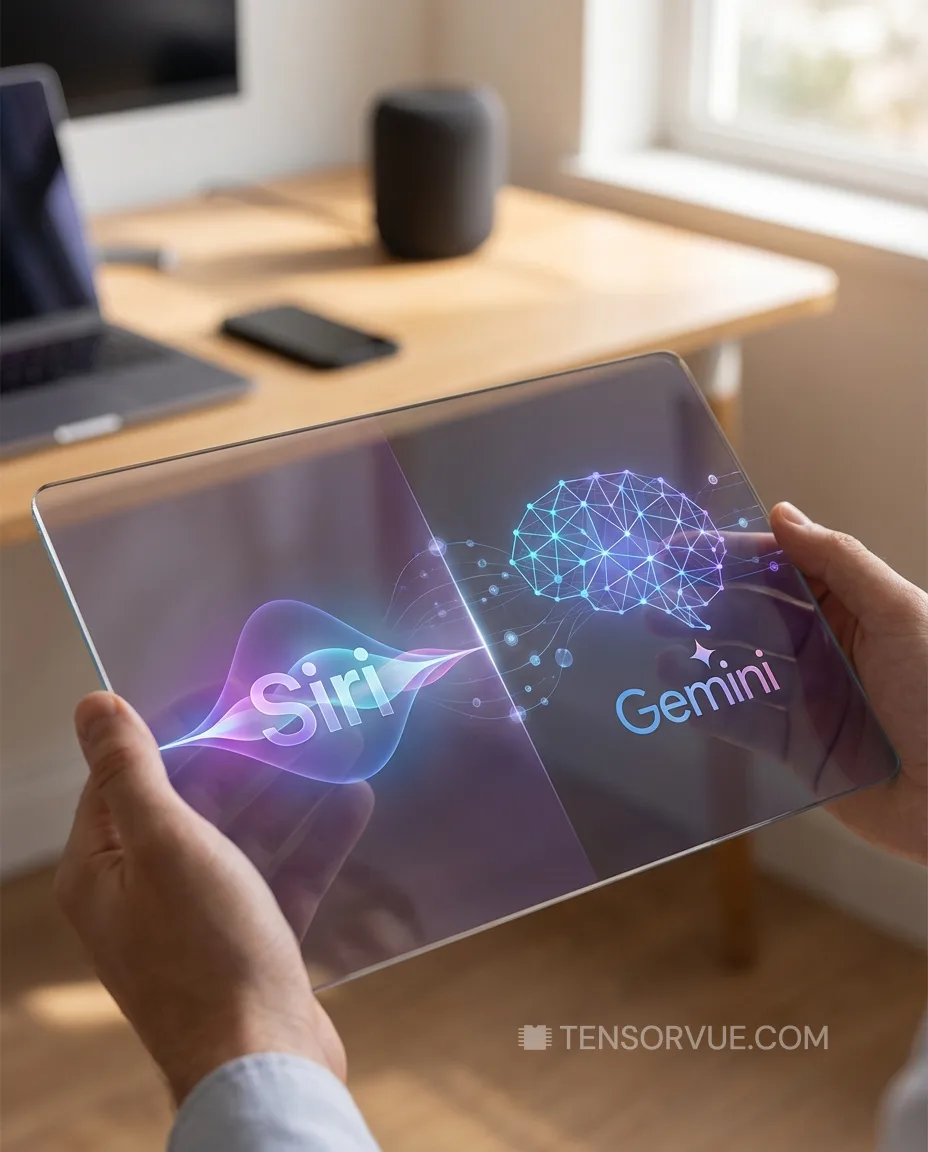
Apple Integrates Google's Gemini AI into Siri in a Deal Worth $1 Billion Annually
In one of the largest AI partnerships announced in 2026, Apple embeds Google's Gemini models directly into Siri, bringing contextual awareness and advanced reasoning to over two billion active Apple devices—while navigating complex privacy and antitrust implications.
Source: Lovable.app / Industry Reports
Key Takeaways
Apple has integrated Google's Gemini AI into Siri through a partnership reportedly worth $1 billion per year. The deal brings on-screen awareness, contextual understanding, and multimodal reasoning to Apple's voice assistant while raising questions about data privacy and regulatory scrutiny.
In a move that reshapes the competitive dynamics of the consumer AI market, Apple has integrated Google's Gemini artificial intelligence models directly into Siri, its voice assistant platform. The partnership, reportedly valued at approximately $1 billion annually, brings advanced contextual reasoning, on-screen awareness, and multimodal understanding to more than two billion active Apple devices worldwide. The integration, which began rolling out in early March 2026, represents Apple's most significant acknowledgment that internal AI development alone cannot keep pace with the capabilities offered by frontier model providers.
What Gemini Brings to Siri
The integration introduces three major capability upgrades to Siri. First, on-screen awareness allows Siri to understand and act upon content currently visible on the user's display—reading a restaurant review and offering to make a reservation, or analyzing a spreadsheet and suggesting formula corrections. Second, contextual understanding enables Siri to maintain conversation context across multiple turns and sessions, remembering user preferences, recent activities, and ongoing tasks. Third, multimodal reasoning allows Siri to process combinations of text, images, and audio simultaneously, enabling scenarios like photographing a broken appliance and receiving step-by-step repair instructions.
The Privacy Architecture
Apple's integration of an externally developed AI model into its ecosystem required resolving fundamental tensions between Google's cloud-based processing model and Apple's privacy-first brand identity. The resulting architecture employs a tiered processing system: simple queries are handled entirely on-device using Apple's own models; moderately complex tasks use Apple's Private Cloud Compute infrastructure; and only the most demanding requests—those requiring Gemini's full reasoning capabilities—are routed to Google's servers, with explicit user consent and data anonymization applied before transmission.
Apple has implemented what it calls 'ephemeral processing' for Gemini-routed queries: Google processes the request and returns results without retaining the query content, user identifiers, or session data. Independent auditors from the Electronic Frontier Foundation have been granted access to verify these privacy protections, though their findings have not yet been published as of March 2026.
Financial and Strategic Implications
The financial architecture of the deal reveals the scale of commitment on both sides. Apple will pay Google approximately $1 billion annually for Gemini integration rights, making it one of the largest AI licensing agreements in history. For Google, this represents both a significant revenue stream and strategic validation of its Gemini platform. The deal positions Google as the default advanced AI provider across Apple's ecosystem of over two billion active devices, effectively giving Gemini the broadest consumer distribution channel of any large language model. For Apple, the cost is substantial but modest relative to its $383 billion annual revenue, and it avoids the multi-year, multi-billion-dollar investment required to develop a competitive frontier model internally. Industry analysts estimate that building a comparable model from scratch would require $10-15 billion in compute infrastructure alone, making the licensing approach a pragmatic strategic choice.
Antitrust Considerations
The partnership inevitably draws comparisons to the existing Google-Apple search deal, in which Google pays Apple an estimated $20 billion annually to remain the default search engine in Safari. That arrangement is currently under scrutiny following the U.S. Department of Justice's antitrust victory against Google in 2024. Legal analysts suggest the Gemini-Siri deal could face similar regulatory challenges, particularly in the EU, where the Digital Markets Act imposes strict obligations on designated 'gatekeepers' regarding interoperability and competitive access.
European regulators have already signaled interest in examining whether the exclusive integration of Google's Gemini into Apple's ecosystem constitutes preferential treatment that disadvantages competing AI providers such as Anthropic, Mistral, and Meta. The European Commission's Digital Markets Act unit has reportedly opened a preliminary inquiry, though no formal investigation has been announced.
Industry Reactions and Competitive Response
Samsung's parallel announcement of embedding Gemini across 800 million devices suggests Google is pursuing an aggressive distribution strategy that leverages hardware partnerships rather than direct consumer acquisition. Microsoft, which has integrated OpenAI's models into Windows through Copilot, now faces a competitive landscape where its primary rival in the consumer device market (Apple) has partnered with its primary rival in the AI model market (Google).
Meta's response has been to accelerate the open-source distribution of its Llama models, positioning itself as the alternative for device manufacturers who wish to avoid dependency on either Google or OpenAI. At Mobile World Congress 2026, Meta CEO Mark Zuckerberg explicitly framed Llama as 'the Android of AI'—a reference to the open-source mobile operating system that, ironically, was also created by Google.
What This Means for Users
For the average iPhone, iPad, or Mac user, the Gemini integration translates into a Siri that is measurably more capable—better at understanding complex requests, maintaining conversation context, and processing visual information. The upgrade arrives as a software update requiring no new hardware purchases, which is likely to drive rapid adoption. However, the tiered processing model means that the most advanced features depend on internet connectivity and user consent to cloud-based processing, creating a two-tier experience between online and offline usage scenarios.
📚 Sources & References
| # | Source | Link |
|---|---|---|
| [1] | Apple Intelligence and Gemini Integration — Overview |
|