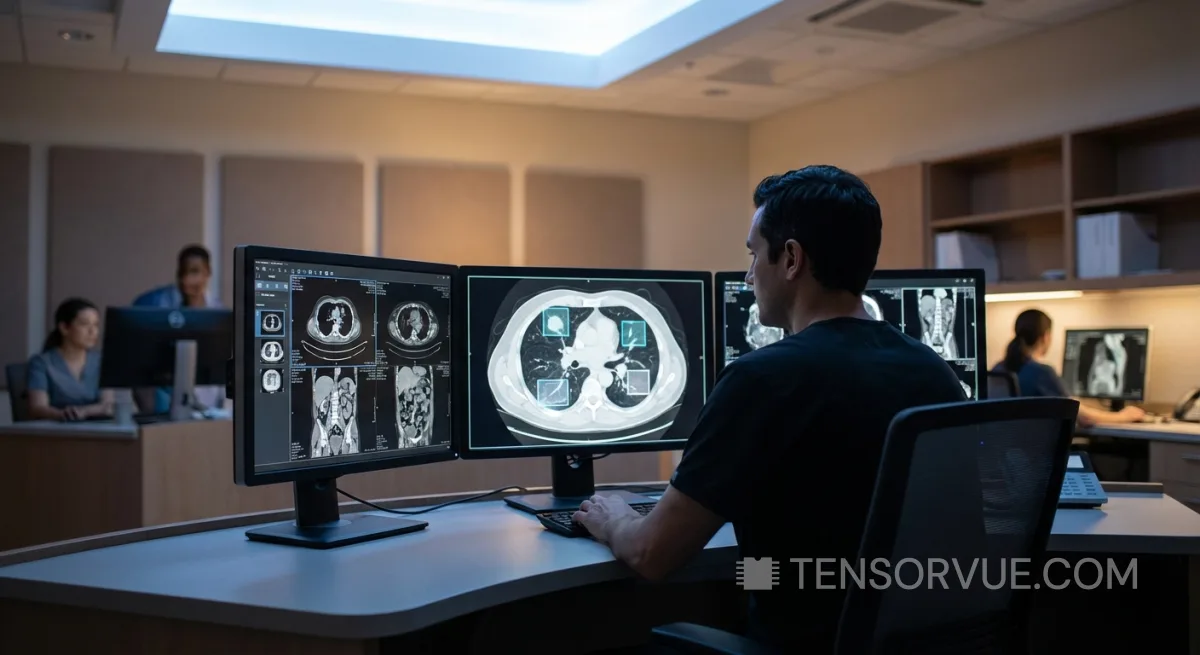
AI in Radiology Surpasses 1,000 FDA-Cleared Algorithms as JACR Focus Issue Examines How Automation Is Reshaping Diagnostic Workflows
The Journal of the American College of Radiology published a special focus issue on March 3, 2026, examining how AI is transforming radiology workflows — arriving at a moment when AI-powered medical imaging has surpassed 1,000 FDA-cleared algorithms and achieved diagnostic accuracy rates reaching 94% for critical conditions.
Source: Journal of the American College of Radiology
Key Takeaways
AI medical imaging has crossed the 1,000 FDA-cleared algorithm milestone, with diagnostic accuracy reaching 94% for critical conditions. The JACR's March 2026 focus issue on AI workflow optimization examines how these tools are reshaping radiology practice, from automated triage to integrated diagnostic pipelines.
On March 3, 2026, the Journal of the American College of Radiology (JACR) released a special focus issue dedicated to what may be the single most successful real-world application of artificial intelligence in healthcare: AI-powered medical imaging. The issue's publication arrives at a symbolic inflection point — AI-enabled medical devices have now surpassed 1,000 clearances from the U.S. Food and Drug Administration, with radiology accounting for the overwhelming majority. The JACR issue, titled 'Impact of AI on Workflow Optimization,' examines not whether AI works in radiology — that question is increasingly settled — but how diagnostic departments should integrate AI tools into their clinical workflows to maximize patient benefit while managing the practical, organizational, and ethical challenges that accompany any transformative technology.
The 1,000-Approval Milestone
The FDA has authorized over 1,000 AI and machine learning-enabled medical devices as of early 2026, with approximately 75% concentrated in radiology applications. These range from automated detection algorithms for lung nodules, breast lesions, and intracranial hemorrhages to more complex systems that measure cardiac ejection fraction, quantify liver fat, and estimate bone age. The cumulative diagnostic accuracy across critical conditions has reached 94% in rigorous clinical validation studies — a figure that approaches and, in some narrow applications, exceeds the performance of experienced human radiologists working without AI assistance.
From Detection to Workflow Integration
The JACR focus issue reflects a maturation in how the radiology community thinks about AI. Early discussions, from roughly 2016 to 2022, were dominated by questions of diagnostic accuracy — can an AI detect a pulmonary embolism? Can it find a fracture that a human misses? The answer, overwhelmingly, has been yes. But detection accuracy alone does not determine clinical value. The focus issue examines the operational questions that determine whether AI actually improves patient outcomes in practice: How should AI findings be presented to reading radiologists? Should AI alerts interrupt the diagnostic workflow or queue in a separate worklist? How do different integration approaches affect reading times, diagnostic confidence, and radiologist fatigue? What happens when an AI system flags a finding that the radiologist disagrees with?
These workflow questions are not merely academic. Poorly integrated AI can increase cognitive load, create alert fatigue, and paradoxically slow the diagnostic process. The JACR issue presents evidence from multiple institutions showing that the impact of AI on radiology depends critically on implementation design — the same algorithm can improve efficiency at one institution and disrupt it at another, depending on how it is embedded in the reading workflow, how its findings are communicated, and how radiologists are trained to interact with its outputs.
Industry Implications
For the medical AI industry, the 1,000-approval milestone and the JACR focus issue together mark a transition from the proof-of-concept era to the implementation era. The commercial landscape for radiology AI is rapidly consolidating: a handful of platform companies — Aidoc, Viz.ai, Qure.ai, and others — are building comprehensive AI suites that integrate multiple detection and quantification algorithms into unified platforms compatible with hospital PACS (Picture Archiving and Communication Systems) and radiology information systems. The challenge is no longer building algorithms that work in controlled settings but deploying them in complex, heterogeneous clinical environments where they interact with diverse patient populations, varying imaging protocols, and overworked clinical teams. The institutions and companies that solve the integration challenge — not just the accuracy challenge — will define the next phase of AI in medicine.
📚 Sources & References
| # | Source | Link |
|---|---|---|
| [1] | FDA-Authorized AI/ML Medical Devices |
|