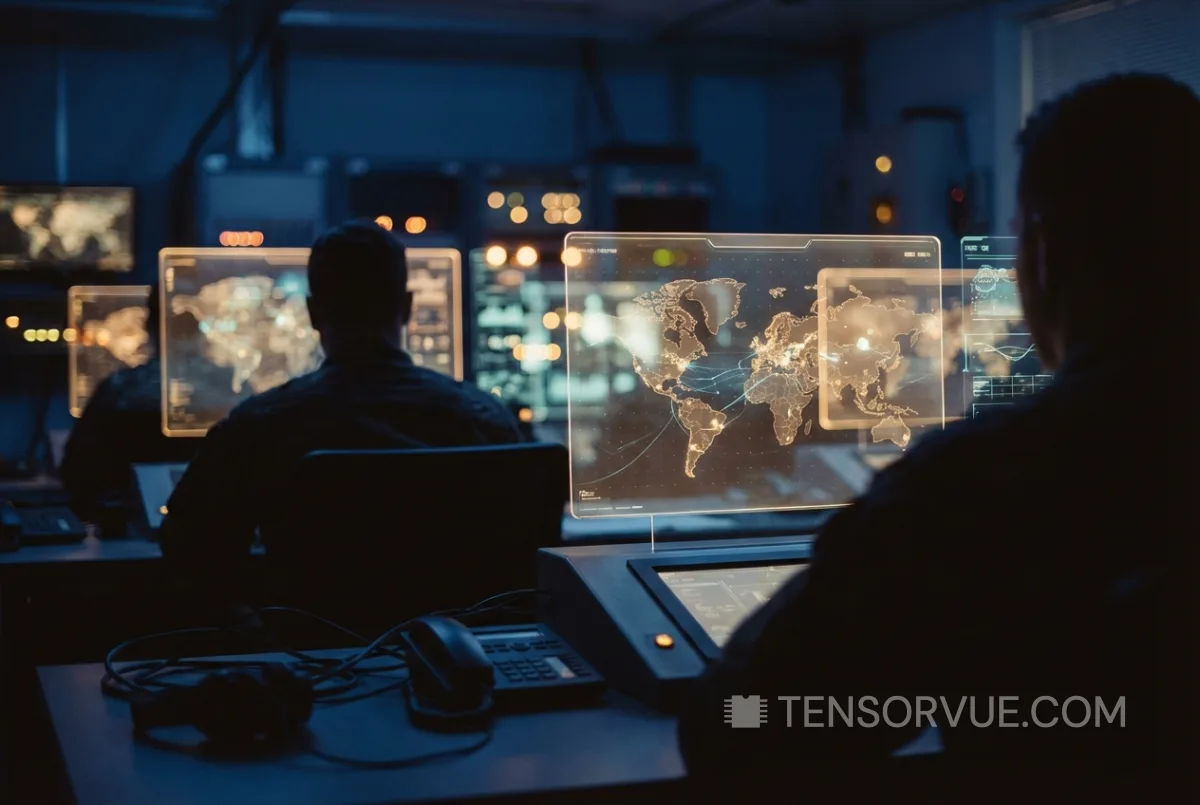
AI-Powered 'Operation Epic Fury': How Artificial Intelligence Is Reshaping Warfare in the Iran Campaign
The U.S.-led military campaign against Iran deploys AI systems including Palantir's Maven Smart System and autonomous drones at a scale nearly double the 2003 'shock and awe,' compressing the kill chain and raising profound ethical questions.
Source: Wall Street Journal
Key Takeaways
The U.S.-led 'Operation Epic Fury' against Iran represents the first large-scale use of AI in active warfare, with Palantir's Maven Smart System serving as the primary AI platform for target identification, logistics optimization, and real-time battlefield coordination.
The U.S.-led military campaign against Iran, designated 'Operation Epic Fury,' represents the most extensive use of artificial intelligence in active military operations in history. Launched on February 28, 2026, the campaign employs AI systems across intelligence analysis, target identification, autonomous drone operations, and cyber warfare — at an operational scale that U.S. Central Command has described as nearly 'double' the 2003 'shock and awe' campaign against Iraq.
The AI Arsenal
Palantir's Maven Smart System serves as the primary AI platform for the campaign, processing vast quantities of satellite imagery and signals intelligence to generate actionable targeting data. Anthropic's Claude AI — despite the company's public objections — is reportedly being used for battle scenario simulation and intelligence prioritization through Palantir's defense integration layer.
The deployment also includes LUCAS (Low-cost Unmanned Combat Attack System) drones — AI-enabled autonomous systems modeled after Iran's own Shahed-136 drones. These systems use computer vision for terminal guidance and can navigate GPS-denied environments, representing a new generation of affordable, semi-autonomous combat systems.
Kill Chain Compression
The most consequential impact of AI in the campaign is 'decision compression' — the dramatic shortening of the time between detecting a target and striking it. Traditional military targeting processes that might take hours or days of human analysis and approval are being compressed to minutes through AI-assisted systems that can process intelligence, identify targets, and recommend strike options at machine speed.
| AI System | Developer | Function in Campaign |
|---|---|---|
| Maven Smart System | Palantir | Intelligence processing, satellite imagery analysis, target prioritization |
| Claude AI | Anthropic (via Palantir) | Battle simulation, intelligence analysis |
| LUCAS Drones | U.S. Defense | Autonomous navigation and targeting in GPS-denied areas |
| Cyber AI Tools | Classified | Infrastructure disruption and signals exploitation |
Iran's AI Countermeasures
Iran has not been passive in the AI domain. The country has reportedly integrated AI technology into its cruise missile systems, claiming capabilities that include mid-flight target changes and ranges exceeding 1,000 kilometers. Iran's Shahed-series drones have also been upgraded with AI-integrated computer vision for terminal guidance — technology that is believed to have been developed with Chinese support.
The Ethical Frontline
Operation Epic Fury has transformed theoretical debates about AI in warfare into immediate practical reality. While proponents argue that AI-assisted targeting improves precision and reduces civilian casualties, critics warn about the risks of AI 'hallucinations' in target recognition and the dangerous compression of human decision-making time in lethal operations. The campaign is widely regarded as a proving ground for algorithmic warfare — and its outcomes will shape military AI policy for decades to come.