Biological Neurons Play Doom: Cortical Labs Demonstrates Living Brain Cells Controlling a Video Game
An Australian biotech company's CL1 biological computer translates Doom's digital signals into electrical stimulation for 200,000 living human neurons, marking a milestone in biological computing.
Source: The Register
Key Takeaways
Australian biotech startup Cortical Labs has demonstrated living brain cells controlling the video game Doom through its CL1 biological computer system. The milestone merges biological and digital computing, translating game information into electrical signals that neurons can process and respond to.
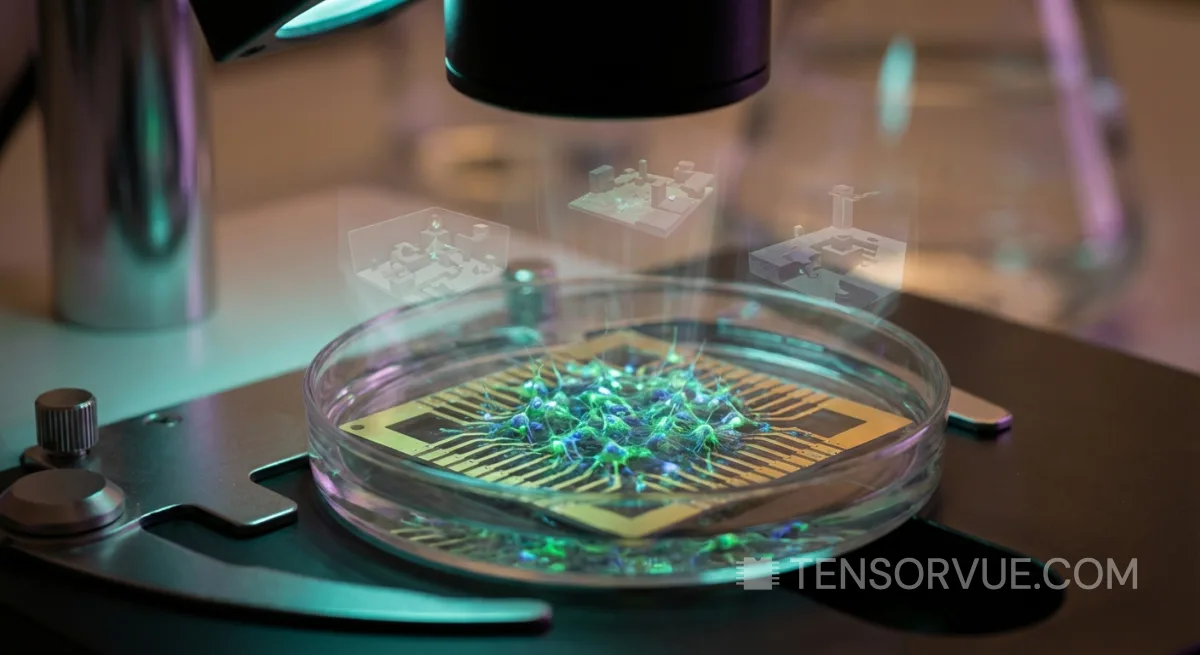
Cortical Labs, an Australian biotech startup, has achieved a remarkable milestone in biological computing: approximately 200,000 living human neurons, cultured on a microelectrode array, have successfully played the classic 1993 first-person shooter Doom. The demonstration represents a significant leap from the company's previous achievement in 2022, when a similar neural culture learned to play the much simpler game Pong.
How Biological Computing Works
Cortical Labs' CL1 biological computer system translates Doom's digital information into electrical signals that stimulate the neural culture through the microelectrode array. The neurons' electrical responses are then interpreted as in-game actions — moving forward, turning, and firing weapons. The process demonstrates a form of reinforcement learning, where the cells adapt their firing patterns based on feedback from the game environment.
From Pong to Doom: A Leap in Complexity
The transition from Pong to Doom represents a dramatic increase in computational complexity. While Pong involves a two-dimensional environment with a single moving object and binary left-right controls, Doom features a full three-dimensional environment with enemies, spatial navigation, weapon selection, and multiple simultaneous input channels. The fact that biological neurons can process and respond to this level of complexity — however imperfectly — is scientifically significant.
The neurons are not considered conscious or aware, and their gameplay performance has been compared to that of a beginner. Nevertheless, the demonstration represents a proof of concept for biological computing architectures that could eventually complement or inform traditional silicon-based approaches.
Implications for Computing and Neuroscience
Cortical Labs' work sits at the intersection of neuroscience, computer science, and bioengineering. The practical implications remain largely theoretical at this stage, but the research opens several promising avenues: understanding how biological neural networks process information could inform the design of more efficient artificial neural networks; biological computing elements could potentially handle specific computational tasks with dramatically lower energy consumption than silicon; and the technology provides a novel platform for pharmaceutical testing and neurological disease research.
The broader field of organoid intelligence — using lab-grown brain organoids for computation — has been gaining momentum alongside Cortical Labs' work. This achievement strengthens the case that biological computing represents a genuine frontier in computer science, not merely a curiosity.