Models & Research

Anthropic's Massive AI Survey: 80,508 People Across 159 Countries Reveal the World's Hopes and Fears About Artificial Intelligence
The largest qualitative AI study ever conducted — powered by an AI interviewer across 70 languages — finds 67% global optimism, but the top fear isn't job loss. It's unreliability. Developing nations see AI as an economic equalizer while wealthy nations worry about governance and cognitive atrophy.

Alibaba Unveils Qwen3.5-Omni: A Native Multimodal AI That Sees, Hears, Speaks, and Reasons in Real Time
Alibaba's Qwen team has released Qwen3.5-Omni, a groundbreaking native omnimodal model built on a novel Thinker-Talker architecture with Hybrid-Attention Mixture of Experts. Trained on over 100 million hours of audio-visual data, it achieves SOTA results across 215 benchmarks while enabling real-time multimodal interaction in 113 languages.
AI Gets a D: New Study Reveals ChatGPT's Alarming Failure Rate on Scientific True-or-False Questions
A rigorous new study from Washington State University tested ChatGPT on 719 scientific hypotheses — and found that once you account for random guessing, the AI barely earns a D grade. Even more troubling: it correctly identified false statements only 16.4% of the time.

Google's Nested Learning Paradigm Reframes Deep Learning as Interconnected Optimization Layers — and Claims to Solve Catastrophic Forgetting
Published at NeurIPS 2025, Google Research's 'Nested Learning' treats neural network architecture and optimization as a single unified system of multi-level learning problems, introducing the self-modifying 'Hope' architecture that outperforms transformers on continual learning benchmarks.

Gemini's Agentic Vision: How Google Taught Its AI to Zoom, Crop, and Annotate Images Like a Human Analyst
Google's new Agentic Vision capability transforms image understanding from a single-shot process into an iterative 'Think, Act, Observe' loop where the model autonomously zooms into details, annotates regions, and runs Python code to verify findings — boosting vision benchmarks by 5-10%.

Inside Cortical Labs: How Living Neurons on Silicon Chips Are Rewriting the Rules of Computing
An Australian biotech startup has grown human brain cells on microchips, taught them to play Pong and Doom, and is now selling the world's first biological computer. A deep dive into the science, the products, and why this matters for the future of AI.

MiniMax M2.5: The Chinese AI Model Challenging Claude Opus at a Fraction of the Cost
Chinese AI company MiniMax has debuted its M2.5 model, which benchmarks show rivaling Anthropic's Claude Opus 4.6 across reasoning and coding tasks — while offering significantly lower API pricing. The release highlights China's rapidly closing gap with Western AI leaders.

OpenAI Launches GPT-5.4 with Enhanced Reasoning as AI Model Race Intensifies
OpenAI has released GPT-5.4, its latest flagship model, featuring significantly improved reasoning capabilities and cognitive density. The launch follows the earlier GPT-5.3 'Garlic' release and marks another milestone in the accelerating AI model competition.
Anthropic's Claude Opus 4.6 Introduces Adaptive Thinking — the Model That Decides When to Think Harder
Anthropic has released Claude Opus 4.6, featuring a novel 'adaptive thinking' mechanism that allows the model to dynamically determine when deeper reasoning is required. The update also introduces context compaction for managing long conversations.
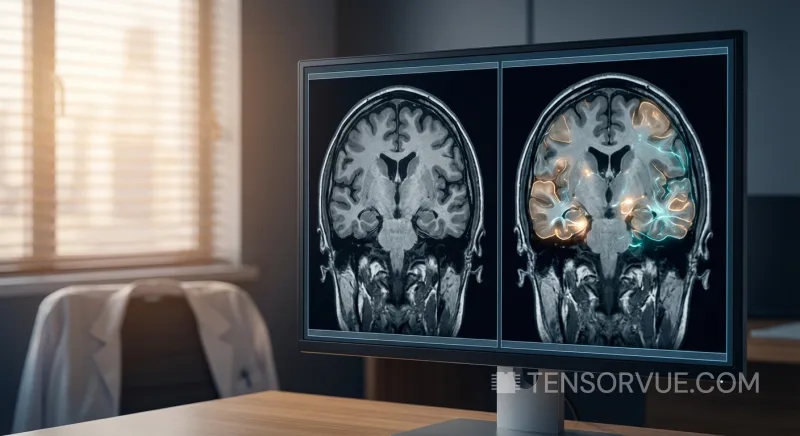
AI Medical Imaging Crosses 1,000 FDA Approvals as Diagnostic Accuracy Reaches 94% for Critical Conditions
With over 1,000 FDA-approved AI imaging tools now in clinical use, artificial intelligence is achieving diagnostic accuracy rates of 94% for breast cancer and heart failure — reducing false negatives by up to 30%.