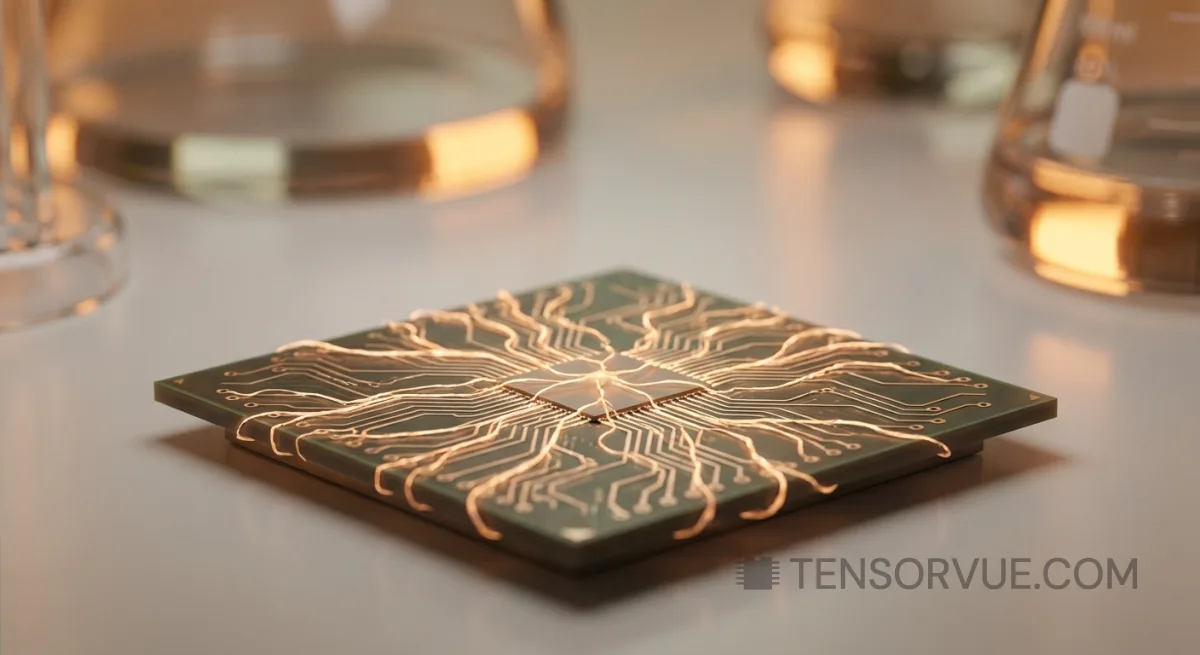
Inside Cortical Labs: How Living Neurons on Silicon Chips Are Rewriting the Rules of Computing
An Australian biotech startup has grown human brain cells on microchips, taught them to play Pong and Doom, and is now selling the world's first biological computer. A deep dive into the science, the products, and why this matters for the future of AI.
Source: Cortical Labs
Key Takeaways
Cortical Labs has created the CL1, the world's first commercially available biological computer that grows living neurons on silicon chips. Their peer-reviewed research in Neuron, Nature Communications, and Communications Biology demonstrates that biological neural networks can learn tasks, exhibit critical dynamics during information processing, and respond to pharmacological intervention — opening doors to drug discovery, energy-efficient computing, and a fundamentally new paradigm beyond traditional AI.
Somewhere in a Melbourne laboratory, human brain cells are playing Doom. Not as a gimmick or a viral marketing stunt — but as a demonstration of what may be the most radical rethinking of computing since the transistor. Cortical Labs, a biotech startup founded in 2019 by physician-turned-entrepreneur Hon Weng Chong, has spent the past seven years doing something that most of the tech industry considered science fiction: growing living neurons directly on silicon chips and programming them to process information, learn from feedback, and perform goal-directed tasks.
The implications are enormous. While the rest of the AI industry is pouring billions into scaling up digital neural networks — models that merely simulate brain-like computation — Cortical Labs is building with the real thing. Their approach, which they call Synthetic Biological Intelligence (SBI), doesn't emulate neurons with mathematics. It uses actual neurons, the product of four billion years of evolution, as the computational substrate. And as of 2025, you can buy their biological computer.
From DishBrain to Doom: The Science That Started It All
The story begins in 2021, when Cortical Labs' Chief Scientific Officer Brett Kagan, PhD, and his team grew approximately 800,000 human cortical neurons on a high-density multielectrode array (HD-MEA) — a specialized silicon chip studded with 26,000 electrodes. They then did something no one had done before: they connected those neurons to a simplified version of the classic video game Pong.
The neurons received electrical stimulation encoding the position of the ball relative to the paddle. Their spontaneous firing patterns were interpreted as paddle movement commands. When they hit the ball successfully, they received predictable feedback; when they missed, the feedback was unpredictable. Over the course of five-minute sessions, something remarkable happened: the neurons reorganized their activity patterns. They began hitting the ball more often. They were learning.
The results, published in October 2022 in the prestigious journal Neuron, sent shockwaves through neuroscience and AI circles. The paper — 'In vitro neurons learn and exhibit sentience when embodied in a simulated game-world' — demonstrated that biological neurons could be 'embodied' in a virtual environment and display goal-directed behavior without any brain, body, or evolutionary history. The key finding was that cultures consistently improved their hit-to-miss ratio over time, far exceeding what random spiking activity would produce.
Critical Dynamics: The Brain's Hidden Operating Principle
Building on the DishBrain breakthrough, a follow-up study published in Nature Communications in August 2023 explored a deeper question: why were the neurons learning? The answer, the researchers found, lies in a phenomenon called neural criticality — a concept from physics where a system operates at the boundary between order and chaos, maximizing its ability to process and transmit information.
The team analyzed 308 experimental sessions across 14 different neural cultures, measuring three independent markers of criticality: the Deviation from Criticality Coefficient (DCC), Branching Ratio (BR), and Shape Collapse error (SC error). When the neurons were resting — not receiving any game input — they showed sub-critical dynamics, meaning their activity was disorganized and inefficient. But the moment they were immersed in the structured information landscape of Pong, the networks reorganized themselves toward a near-critical state.
The precision of this result was striking. Using criticality metrics alone, the researchers could predict with 92.41% accuracy whether a given culture was actively engaged in gameplay or resting. When performance data was included, accuracy jumped to 98.21%. The findings were consistent across both human iPSC-derived neurons and mouse cortical neurons, and across both sensory and motor subpopulations within the cultures.
| Metric | Critical Value | Gameplay (Mean) | Rest (Mean) | p-value |
|---|---|---|---|---|
| Deviation from Criticality (DCC) | 0 | 0.296 ± 0.015 | 0.627 ± 0.087 | <5×10⁻⁶ |
| Branching Ratio (BR) | 1.0 | ~0.98 | ~0.85 | <5×10⁻¹³ |
| Shape Collapse Error | 0 | Lower | Higher | <5×10⁻⁷ |
| Hit/Miss Ratio | — | 1.58 | 1.02 | <5×10⁻⁶ |
What makes this finding particularly significant is that it addresses a decades-old debate in neuroscience. Scientists have long observed signatures of criticality in living brains, but it was never clear whether criticality is an intrinsic property of neural tissue or whether it arises only when neurons process structured information. The Cortical Labs data strongly supports the latter interpretation: criticality appears to be a fundamental computational strategy that emerges when biological neural networks engage with the world.
From Pong to Pharma: Drug Testing on Living Neurons
If growing neurons can learn to play games, can they also be used to test drugs? That question drove the most recent major publication from Cortical Labs, published in June 2025 in Communications Biology (Nature). The study represents the first demonstration that pharmacological compounds can alter information-processing performance in a Synthetic Biological Intelligence system — a result with profound implications for drug discovery.
The researchers used NGN2-reprogrammed human iPSC-derived neurons to create an in vitro model of glutamatergic hyperactivity — a condition associated with epilepsy and other neurological disorders. These hyperactive cultures were exposed to three anti-seizure medications: phenytoin, perampanel, and carbamazepine, and then evaluated both in standard spontaneous activity assays and in the DishBrain gameplay environment.
The key finding was striking in its specificity: while all three compounds reduced spontaneous firing rates, only carbamazepine at 200 µM significantly improved gameplay metrics. The treated neurons hit the ball more often, sustained longer rallies, and scored fewer immediate misses (aces) than untreated or alternatively treated cultures. This marks the first time that an exogenous drug has been shown to enhance goal-directed behavior in a synthetic biological intelligence system.
The pharmacological results went beyond simple performance metrics. The team conducted comprehensive neurocomputational analyses, including functional connectivity mapping and criticality assessments. They found that carbamazepine-treated networks maintained more stable functional connectivity during gameplay, while phenytoin and perampanel-treated cultures rapidly lost the neural reorganization patterns that emerge during embodiment — essentially reverting to resting-state dynamics even while receiving game input.
The CL1: The World's First Commercial Biological Computer
All of this research has converged into a commercial product: the CL1, which Cortical Labs describes as the world's first code-deployable biological computer. Detailed in a 2025 Nature Reviews Bioengineering paper by Brett Kagan, the CL1 is a scalable device that integrates living neural cultures with silicon hardware in a closed-loop, real-time computing environment, complete with an integrated life-support perfusion circuit that keeps the neurons alive and healthy.
The architecture is deceptively elegant. Real neurons are cultivated inside a nutrient-rich solution that supplies everything they need to survive. They grow across a custom silicon chip, which can both send and receive electrical impulses into the neural structure. The Biological Intelligence Operating System (biOS) creates a simulated world and sends information directly to the neurons about their environment. As the neurons react, their impulses affect the simulated world — creating a true closed-loop system.
Users can deploy code directly to the neurons via a Python SDK, either locally on a CL1 device or remotely through the Cortical Cloud — a biological cloud computing platform accessible from any browser via Jupyter notebooks. The cloud platform allows researchers to interact with arrays of CL1 devices without the need for a specialized laboratory, radically democratizing access to biological neural computing.
Inside the Machine: How CL1 Keeps Neurons Alive
Perhaps the most common question about biological computing is also the most practical: how long do the neurons actually live? The answer, drawn directly from Cortical Labs' peer-reviewed publications, reveals both the current limitations and the engineering solutions that make the CL1 viable as a product.
The neurons used in CL1 systems are not extracted from a living brain. They are grown from human induced pluripotent stem cells (iPSCs) — essentially adult cells reprogrammed back to a stem cell state and then guided to differentiate into cortical neurons. The differentiation process takes approximately 7 days with doxycycline induction; the neurons are then plated onto the HD-MEA chip along with supporting astrocytes (glial cells that provide structural and metabolic support). From there, the cultures need 2 to 5 weeks to mature — developing synaptic connections, establishing network-wide burst activity, and reaching the electrical activity threshold (an average firing rate of 0.7 Hz) required for computational tasks. In the drug testing study published in Communications Biology (2025), cultures were confirmed active at day 28 and immunocytochemistry verified healthy neurons with mature synaptic markers at day 38 post-differentiation.
The original DishBrain system had a significant practical limitation. As the researchers noted in their 2025 pharmacology paper: the heat generated by the multielectrode array system caused evaporation of the culture medium, changes in osmolarity, and potentially electrolysis at the stimulating electrodes. 'Prolonged testing eventually results in degradation of cell health and eventual cascades of cell death in the cultures.' This restricted experimental sessions to approximately 60 minutes per day, with cultures tested for a maximum of four consecutive days of gameplay before needing replacement. Half of the culture medium had to be changed every second day to keep the neurons viable.
The CL1 was specifically engineered to solve this longevity problem. Its integrated perfusion circuit — described in the Nature Reviews Bioengineering paper as an 'integrated life-support perfusion circuit' — continuously circulates fresh nutrient medium over the neurons, maintaining temperature, pH, osmolarity, and waste removal in real time. This closed-system approach mirrors the role that blood vessels play in the living brain, providing constant homeostatic control of the culturing environment. While Cortical Labs has not published an exact maximum lifespan figure for CL1-maintained cultures, the perfusion system fundamentally changes the equation: instead of hours of viable computing time per session (limited by medium evaporation), the neurons can maintain their activity and health continuously for extended periods — potentially weeks to months under optimal conditions.
For customers purchasing a CL1 device (priced in the thousands of dollars range for research institutions), the practical workflow involves receiving the hardware platform and sourcing neural cultures — either growing them in-house from iPSC lines or obtaining pre-differentiated cultures. The biological component is loaded onto the MEA chip and maintained by the perfusion system. When a culture eventually reaches the end of its functional lifespan, it is replaced with a fresh one — conceptually similar to replacing a consumable cartridge. The Cortical Cloud alternative bypasses this entirely: Cortical Labs maintains the biological infrastructure at their Melbourne facility, and researchers interact with live neurons remotely via Jupyter notebooks and Python SDK, with no need for a lab, incubator, or cell culture expertise.
Why This Matters: The Energy Problem
To understand why biological computing matters, consider the energy crisis facing artificial intelligence. Training GPT-4 consumed an estimated 50 gigawatt-hours of electricity. Running large language models for inference costs data centers billions of dollars annually. The human brain, by contrast, operates on roughly 20 watts — about the same as a dim light bulb — while performing computations that the most powerful supercomputers still cannot replicate.
Biological neurons achieve this efficiency because they are fundamentally different from transistors. A transistor is a binary switch — on or off, 1 or 0. A neuron is a programmable, self-organizing computational unit that can form thousands of connections, modulate its own sensitivity, and reconfigure its network architecture in real time. Digital AI models spend enormous resources trying to approximate what evolution perfected over billions of years. Cortical Labs begins with the real thing.
This isn't just an academic curiosity. The global neuroscience market is projected to exceed $38 billion by 2027, with drug discovery alone representing a multi-billion-dollar opportunity. The failure rate in CNS (central nervous system) drug development exceeds 90%, largely because existing in vitro models fail to capture the information-processing functions of neural tissue. If the DishBrain system can consistently predict drug efficacy — as the carbamazepine results suggest — it could fundamentally transform preclinical neuropharmacology while reducing dependence on animal testing.
The Publication Machine: 22 Papers and Counting
What distinguishes Cortical Labs from many AI startups is the depth and rigor of their scientific output. The company has published or co-authored over 22 peer-reviewed papers across top-tier journals, including Neuron, Nature Communications, Communications Biology, Nature Reviews Bioengineering, Frontiers in Science, the Journal of Neuroscience, Biotechnology Advances, and Cell Biomaterials.
| Paper | Journal | Year | Key Finding |
|---|---|---|---|
| DishBrain: Neurons learn Pong | Neuron | 2022 | First demonstration of goal-directed learning in vitro |
| Critical dynamics in SBI | Nature Communications | 2023 | Neural criticality emerges during structured information processing |
| Drug effects on SBI | Communications Biology | 2025 | First pharmacological modulation of biological computing performance |
| CL1 platform technology | Nature Reviews Bioengineering | 2025 | Architecture of the first commercial biological computer |
| Organoid Intelligence (OI) | Frontiers in Science | 2023 | Roadmap for computing with brain organoids |
| SBI opportunities & challenges | Biotechnology Advances | 2023 | Comprehensive review of the field's potential and hurdles |
| Starting an SBI lab | Cell Patterns | 2025 | Practical guide for new research groups entering the field |
| CL API | arXiv | 2026 | Open real-time closed-loop API for biological neural networks |
The research spans an increasingly broad set of topics: from the fundamental neuroscience of criticality and information processing to practical questions about drug testing, ethical frameworks for 'embodied' neurons, hippocampal neuron generation protocols, and even the philosophical question of whether neurons in a dish can have morally relevant states. This last topic — explored in a 2022 paper in the AJOB Neuroscience journal — positions Cortical Labs at the intersection of some of the most important ethical debates in modern science.
The Team Behind the Breakthrough
Cortical Labs is led by a compact but formidable team. Founder and CEO Hon Weng Chong, MD, brings a medical background that grounds the company's vision in practical health applications. Chief Scientific Officer Brett Kagan, PhD, is the scientific engine behind DishBrain and the lead or co-author on nearly all of the company's publications. Chief Technology Officer David Hogan and Chief Hardware Officer Andrew Doherty handle the silicon and engineering sides. The team is based in Melbourne, Australia, and has built everything from the ground up — quite literally, as documented in their 2025 Patterns paper 'Starting a Synthetic Biological Intelligence Lab from Scratch.'
Competitive Landscape and Future Directions
Cortical Labs is not entirely alone in the biological computing space. The concept of 'Organoid Intelligence' (OI) — using three-dimensional brain organoids for computation — was proposed in a 2023 Frontiers in Science paper co-authored by researchers from Johns Hopkins University and other institutions. Chinese research groups have demonstrated brain organoids performing reservoir computing tasks. FinalSpark, a Swiss company, operates a similar neuroplatform.
However, Cortical Labs appears to hold a significant first-mover advantage. They are the only company that has: (1) demonstrated learning in biological neurons with peer review in a top journal, (2) shipped a commercial biological computer, (3) demonstrated pharmacological modulation of SBI performance, and (4) published open APIs for programmatic interaction with biological neural networks. Their 2026 CL API preprint on arXiv — providing a real-time, closed-loop interface to biological neurons — signals the beginning of a developer ecosystem that could accelerate the field dramatically.
What Comes Next
The trajectory from 'neurons playing Pong' to 'neurons running Doom' to 'neurons testing epilepsy drugs' tells a story of a technology that is maturing rapidly. The most recent YouTube demonstration — showing Doom running on a CL1 connected to the Cortical Cloud, with source code available on GitHub — suggests that Cortical Labs is transitioning from a research curiosity to a platform that developers and researchers can actually build on.
The potential applications stretch across multiple industries. In pharmaceutical development, the DishBrain system could dramatically reduce the cost and time of preclinical drug screening while decreasing reliance on animal models. In computing, biological neural networks could address the energy and scalability challenges that are beginning to constrain traditional AI. In neuroscience, the platform offers a controlled, reproducible system for studying fundamental questions about learning, memory, and consciousness without the ethical complications of in vivo research.
Cortical Labs has not yet disclosed detailed financial information or funding rounds publicly, but their ability to ship a commercial product, maintain a substantial research publication pipeline, and build a cloud platform suggests significant backing and operational maturity. The global neuroscience and biocomputing markets are projected to reach tens of billions in the coming years, and Cortical Labs is positioned at the exact intersection of the fields that will drive that growth.
Whether biological computing will eventually replace or complement silicon-based AI remains an open question. But the evidence from Cortical Labs — peer-reviewed, replicated, and now commercialized — suggests that the answer is no longer 'if' but 'when.' The neurons are already learning. The question is what we choose to teach them next.
📚 Sources & References
| # | Source | Link |
|---|---|---|
| [1] | Critical dynamics arise during structured information presentation within embodied in vitro neuronal networks |
|
| [2] | Drug treatment alters performance in a neural microphysiological system of information processing |
|
| [3] | The CL1 as a platform technology to leverage biological neural system functions |
|