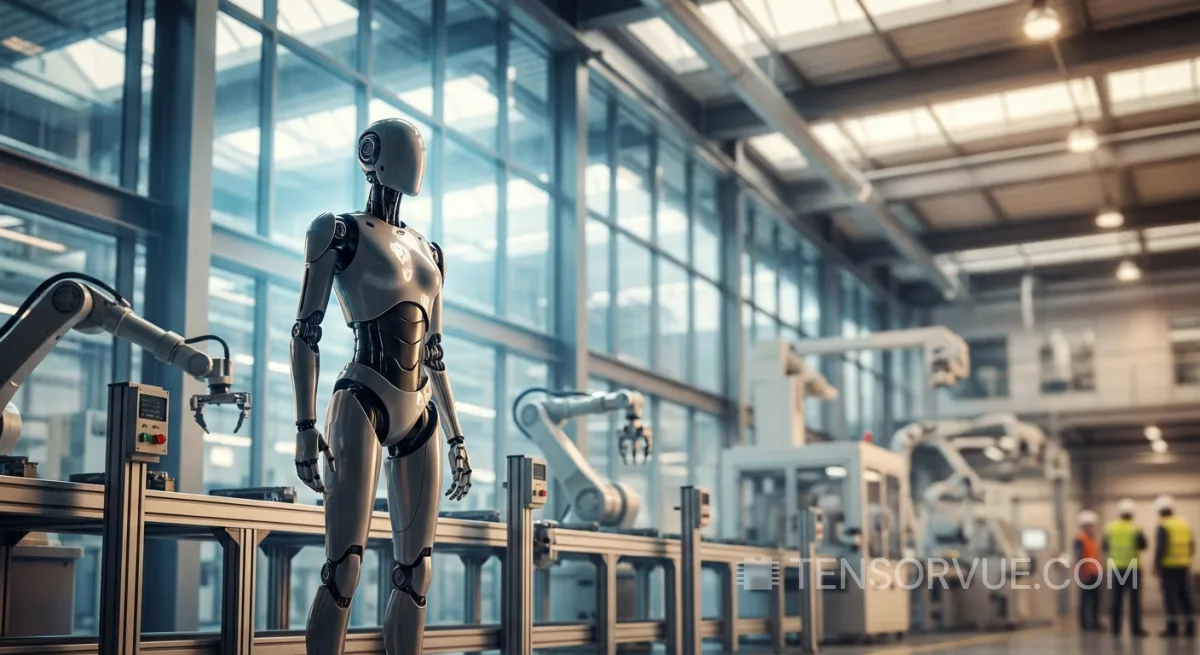
Deep Dive: Inside Neura Robotics — The Technology, Strategy, and Risks Behind Europe's Biggest Humanoid Bet
Neura Robotics has secured a €1 billion funding round backed by Tether, valuing the Metzingen-based company at €4 billion. With 77 patents, a €1 billion order book, and partnerships with Nvidia, Bosch, and Omron, the company is positioning Europe as a serious contender in the global humanoid robotics race.
Source: Bloomberg
Key Takeaways
Neura Robotics, a German cognitive robotics startup founded in 2019, has raised €1 billion in funding led by Tether Holdings, valuing the company at approximately €4 billion. The deep-dive analysis examines how the company built a vertically integrated robotics ecosystem spanning cobots, humanoid robots, and an AI platform — and why investors see it as Europe's strongest bet against US and Chinese competitors in the emerging physical AI market.
In March 2026, Bloomberg reported that Neura Robotics — a five-year-old German startup headquartered in Metzingen, a small town near Stuttgart better known as the home of Hugo Boss — was closing a €1 billion funding round. The lead investor: Tether Holdings, the issuer of the world's largest stablecoin, USDT. The deal values Neura at approximately €4 billion, making it one of Europe's most valuable private robotics companies and the continent's most ambitious bet on humanoid robots. [1]
The raise is staggering by European standards and represents one of the largest single-round investments in the robotics industry globally. But behind the headline number lies a deeper story: a company that has methodically built an end-to-end cognitive robotics ecosystem, secured partnerships with industrial giants, and positioned itself at the intersection of artificial intelligence and physical manufacturing — the so-called 'physical AI' frontier.
The Founder: From Social Work to Cognitive Robotics
David Reger, Neura's founder and CEO, has an unconventional background for a robotics mogul. Before entering the tech world, he worked as a social worker in San Francisco, helping reintegrate formerly incarcerated individuals into society. This experience instilled a foundational belief that technology should serve humanity — a philosophy he would later embed into Neura's mission to create 'cognitive robots as partners in a modern social society.'
After returning to Europe, Reger built and led several high-tech automation companies in Switzerland before founding Neura Robotics in 2019. He is credited with coining the term 'cognitive robotics' and holds 17 patents personally. In 2025, he was named 'Innovator of the Year' and appointed to both the Senate of German Business and the European Senate of Business and Technology. [2]
The Product Ecosystem: More Than Just a Humanoid
What distinguishes Neura from many humanoid robot startups is the breadth of its product line. While the 4NE-1 humanoid grabs headlines, the company generates revenue today from multiple robot platforms that share a unified cognitive AI stack and the Neuraverse software ecosystem.
| Product | Type | Key Specs | Target Market |
|---|---|---|---|
| MAiRA | Cognitive Cobot | 0.01mm repeatability, TÜV-certified safety (PL e / SIL 3), 15-18kg payload | Industrial manufacturing, assembly, quality inspection |
| LARA | Lightweight Cobot | ±0.02mm precision, 3-30kg payload models, visual programming | SME automation, pick-and-place, machine tending |
| 4NE-1 | Humanoid Robot | 170-180cm, 80kg, 55 DOF, 15kg per arm, 5-hour runtime | Logistics, manufacturing, healthcare, household |
| MiPA | Personal Assistant | Multi-purpose household robot | Consumer, service industry |
| MAV | Mobile Vehicle | Autonomous mobile platform | Intralogistics, material transport |
The 4NE-1: Europe's Flagship Humanoid
The 4NE-1 stands 170-180 centimeters tall, weighs about 80 kilograms, and boasts 55 degrees of freedom for full-body articulation. Each arm can lift 15 kilograms in standard configuration — with third-generation arms promising up to 100 kilograms. It walks at 3-5 km/h and operates for up to five hours per charge, with a dual-battery system designed for 24/7 operation in planned future generations.
What makes the 4NE-1 technically distinctive is its sensor architecture. The patented Omnisensor fuses data from multi-camera 360° vision, 3D depth sensors, LIDAR, and a spatial audio system to create real-time environmental awareness. The robot's full-body 'artificial skin' — a tactile sensor mesh — can detect human proximity before physical contact occurs, enabling it to operate without safety cages in shared workspaces. [2] [5]
The cognitive AI stack runs on-device with edge processing for low latency, built on Nvidia's Isaac GR00T platform. The robot can interpret natural language commands, learn tasks from demonstration, adapt to unstructured environments, and even recover from falls autonomously. At CES 2026, Neura demonstrated the 4NE-1 performing a backflip — a dramatic proof of its bipedal control algorithms.
Neuraverse: The App Store for Robots
Perhaps Neura's most strategically important asset is the Neuraverse — a proprietary, open robotics ecosystem described as an 'app store' for robot skills. Partners and developers can build applications (skills) that run across Neura's entire robot lineup, from the LARA cobot to the 4NE-1 humanoid. Crucially, robots within the Neuraverse practice networked learning: when one robot masters a task in a warehouse in Munich, that knowledge can be transferred to every other connected Neura robot worldwide.
The platform is designed with modular security so companies can collaborate without exposing proprietary data. This mirrors the smartphone ecosystem model — Neura builds the hardware and OS, while an expanding developer community creates the applications. Reger has described the vision as creating a 'smartphone with arms and legs.'
The Patent Fortress
Neura Robotics holds 77 patents globally, with 43 granted and 73 active. This is a substantial IP portfolio for a company founded just five years ago, and it covers the full technology stack: AI algorithms, sensor fusion, the Omnisensor, control software, and mechanical design. The company builds all key technologies in-house — a deliberate strategy that gives it tight control over the supply chain and enables rapid iteration.
In a significant strategic move, Neura relocated its production from China to Germany in February 2024, emphasizing 'Made in Germany' quality standards and reducing dependency on Chinese manufacturing. This reshoring also strategically positions the company for European government and defense contracts where provenance matters.
Following the Money: Why Tether and Why Now?
The €1 billion round follows a €120 million Series B closed in January 2025 and an earlier $55 million raise in mid-2023. The funding trajectory reflects both Neura's rapid commercial growth and the explosive investor interest in physical AI. [3]
Tether's involvement deserves particular scrutiny. The stablecoin issuer, which reported record profits exceeding $10 billion in 2025, has been aggressively diversifying into 'frontier tech' — the company has also invested in Blackrock Neurotech (brain-computer interfaces) and Generative Bionics. For Tether, the thesis is straightforward: AI and robotics represent the next major infrastructure cycle, and Neura offers an entry point into a market that Goldman Sachs projects could reach $38 billion by 2035 — with long-term ARK Invest estimates as high as $24 trillion. [1] [4]
From Neura's perspective, the capital will fund three priority areas: scaling manufacturing from prototypes to volume production, expanding the global R&D footprint (including a new 1,800 m² hub in Zurich opened in January 2026), and establishing Nvidia physical AI training centers in Germany. The company has announced ambitions to produce 5 million intelligent robots by 2030.
Commercial Traction: A €1 Billion Order Book
What separates Neura from many AI robotics startups is that it already generates meaningful revenue. The company reported a tenfold increase in revenue in 2024, with estimated annual revenue approaching $157 million and an order book totaling approximately €1 billion.
Key revenue drivers include white-label cobot sales to major industrial partners. Kawasaki Heavy Industries integrates and resells Neura's cobots as its CL Series. Omron, one of Japan's largest automation companies, launched the entire iCR (intelligent Cognitive Robot) product line based on Neura's MAiRA platform in April 2024. [5] These partnerships give Neura access to established global distribution channels without building its own sales infrastructure from scratch.
The Strategic Partnership Web
Neura has assembled a partnership network that reads like a who's-who of industrial technology:
- Nvidia — Joined the Humanoid Robot Developer Program; uses Isaac GR00T platform; co-developing physical AI training centers in Germany
- Bosch — Strategic partnership announced January 2026 for developing and scaling humanoid robots in industrial production
- Omron — iCR cognitive robot series derived from Neura's MAiRA; deep manufacturing integration
- Kawasaki — CL Series cobots; major customer and distribution partner
- SAP — Joint initiative with Nvidia to deploy physical AI across enterprise operations using SAP's business process intelligence
The Bosch partnership is particularly significant. Bosch brings manufacturing scale, automotive-sector relationships, and deep engineering culture. For a humanoid robot to succeed in real factories, it needs the endorsement and integration support of companies that run those factories — and Bosch is exactly that. [6]
The Competitive Landscape: How Neura Stacks Up
Neura Robotics operates in an increasingly crowded field. The global race to build commercially viable humanoid robots now spans three continents, with each major player pursuing different strategies for market entry and technological differentiation.
| Company | Robot | Focus | Key Advantage | Funding to Date |
|---|---|---|---|---|
| Neura Robotics | 4NE-1 | Industrial + Consumer | Full ecosystem (cobots → humanoid), Neuraverse platform | ~€1.2B |
| Figure AI | Figure 03 | Manufacturing → General purpose | OpenAI integration, BMW deployment | ~$750M |
| Tesla | Optimus | General purpose | FSD AI transfer, massive capital | Internal |
| Agility Robotics | Digit | Logistics | Amazon deployment, RoboFab factory (10K units/yr) | ~$400M |
| 1X Technologies | NEO | Consumer household | Tendon-driven design, $20K price point | ~$125M |
| Agile Robots | Agile ONE | Industrial | World-leading dexterous hands | ~$220M |
Neura's positioning is unique among these competitors: it is the only company that both sells revenue-generating cobots today and develops a humanoid robot. While Figure AI relies on external AI partnerships (OpenAI) and Tesla leverages its autonomous driving stack, Neura controls its entire technology stack vertically — from sensors and actuators to AI software and the Neuraverse platform. This vertical integration may prove to be a key competitive moat, enabling faster iteration and tighter hardware-software co-optimization.
Scale and Global Footprint
The company has grown to over 1,200 employees from more than 45 countries, spread across 8+ locations worldwide. The headquarters in Metzingen houses both R&D and manufacturing. A Munich engineering hub focuses on AI development and manages global sales. The new Zurich facility serves as a physical AI research center, while a Hangzhou operation acts as a data-driven robotics training hub and gateway to the Chinese market. Further US expansion into Detroit, Boston, and Silicon Valley is planned.
What Could Go Wrong
For all the momentum, Neura faces substantial risks. The humanoid robotics space is littered with overpromise — Boston Dynamics spent decades developing Atlas before Hyundai acquired the company, and commercially viable humanoids remain more aspiration than reality for most players. Key risk factors include:
- Manufacturing scale-up: Moving from prototype to millions of units is an order-of-magnitude engineering and supply-chain challenge
- Unit economics: At estimated six-figure price points, humanoid robots need to demonstrate clear ROI versus human labor or simpler automation
- Regulatory uncertainty: Safety certifications for autonomous humanoid robots in workplaces and homes remain undeveloped in most jurisdictions
- Competitive pressure: Chinese manufacturers have released over 300 types of humanoid robot products, and Japan has announced plans to capture 30% of the global AI robot market by 2040
- Tether dependency: A single dominant investor from the cryptocurrency world introduces both concentration risk and potential reputational questions for enterprise customers
The Bigger Picture: Europe's Physical AI Moment
Neura's €1 billion raise is not just a company story — it's a signal about Europe's strategic ambitions in physical AI. While much of the AI conversation has been dominated by US and Chinese companies, the robotics hardware layer is one area where European engineering traditions and manufacturing precision offer genuine competitive advantages.
Germany, in particular, brings a unique ecosystem: the world's third-largest concentration of industrial robots (after China and Japan), deep expertise in precision manufacturing, a dense network of Mittelstand automation companies, and a labor market with structural shortages that create pull-demand for robotic solutions. If Neura can execute on its vision, it could establish Europe as a third pole in the global humanoid robotics race — a market that Goldman Sachs conservatively estimates at $38 billion by 2035 and that some analysts believe could eventually rival the automotive industry in economic impact. [4]
The Verdict
Neura Robotics is not simply a startup that raised a lot of money. It is a vertically integrated cognitive robotics company with shipping products, a billion-dollar order book, heavyweight industrial partnerships, and a substantial patent portfolio — all built in five years. The €1 billion Tether-backed round gives it the capital to attempt what no European robotics company has done before: mass-produce humanoid robots at scale.
Whether the company can deliver on its ambition to deploy 5 million robots by 2030 remains an open question. The technology works in demos; the real test is whether it works reliably at scale, in unstructured real-world environments, at price points that make economic sense. But with this funding, Neura has bought itself the runway to try — and positioned itself as the leading European contender in what may become one of the defining industries of the next decade.
📚 Sources & References
| # | Source | Link |
|---|---|---|
| [1] | Tether Is Said to Invest in German Humanoid Robot Startup Neura |
|