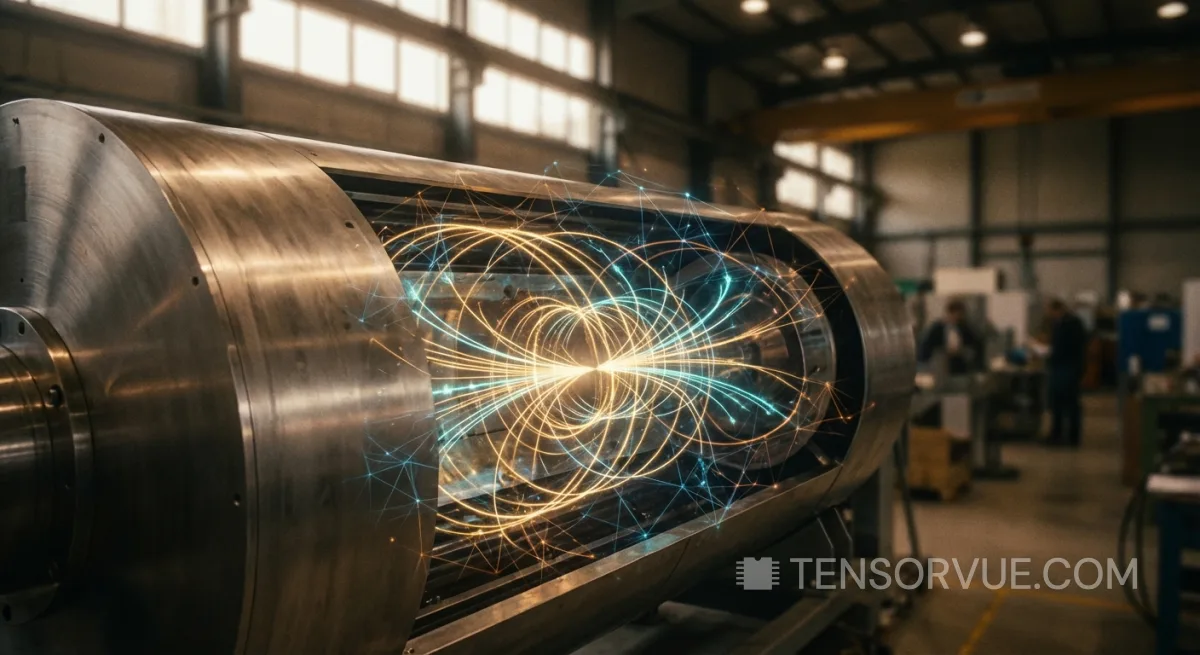
CERN's CMS Experiment Achieves First Full Machine Learning Reconstruction of Particle Collisions
The CMS Collaboration demonstrates a breakthrough machine-learning particle-flow algorithm that surpasses traditional methods in both speed and precision, improving jet energy resolution by 10–20% for key physics processes.
Source: CERN
Key Takeaways
CERN's CMS experiment has achieved the first full machine learning reconstruction of particle collisions, replacing hand-tuned algorithms with ML models that can process the massive data outputs of the Large Hadron Collider. The advance could accelerate physics discoveries by enabling more efficient data analysis.
The CMS Collaboration at CERN has announced a landmark achievement in computational physics: the first full reconstruction of Large Hadron Collider particle collisions using a machine-learning-based particle-flow (MLPF) algorithm. The new approach, demonstrated in February 2026, surpasses traditional hand-crafted reconstruction methods in both processing speed and measurement precision.
Learning Directly from Collisions
Unlike traditional particle-flow algorithms, which rely on painstakingly hand-tuned rules developed over decades, the MLPF algorithm learns directly from simulated collisions. This approach allows the system to discover optimal reconstruction strategies that human physicists might not have considered, resulting in measurably better performance across multiple physics metrics.
The algorithm leverages modern Graphics Processing Units (GPUs) for efficient processing, significantly reducing reconstruction time compared to traditional CPU-based methods. For simulated top quark-antiquark events, the MLPF algorithm improved jet energy resolution by 10–20% in certain momentum ranges — a substantial improvement in a field where even single-percentage-point gains represent years of development effort.
Preparing for the Data Deluge
The timing of this breakthrough is critical. The High-Luminosity LHC (HL-LHC), scheduled to commence operations in 2030, will produce five to ten times more particle collisions per second than the current LHC configuration. CERN projects that its computing power will fall 10 to 100 times short of what the HL-LHC will require using current algorithms — making machine learning essential for the future of particle physics.
Beyond Reconstruction
The MLPF achievement is part of a broader transformation in how particle physics experiments process data. Machine learning is being deployed across the entire physics pipeline: from trigger systems that decide in real-time which collisions to record, through track reconstruction algorithms that trace particle paths through detectors, to generative models that can simulate collision events up to 40 times faster than conventional Monte Carlo methods.
CERN's incoming Director General, Prof. Mark Thomson, has emphasized that AI will 'revolutionize fundamental physics,' potentially leading to new discoveries and guiding the reevaluation of existing theories. The successful deployment of MLPF represents a concrete validation of that vision — demonstrating that machine learning can not only process physics data more efficiently but can actually extract more information from the same data than traditional methods.