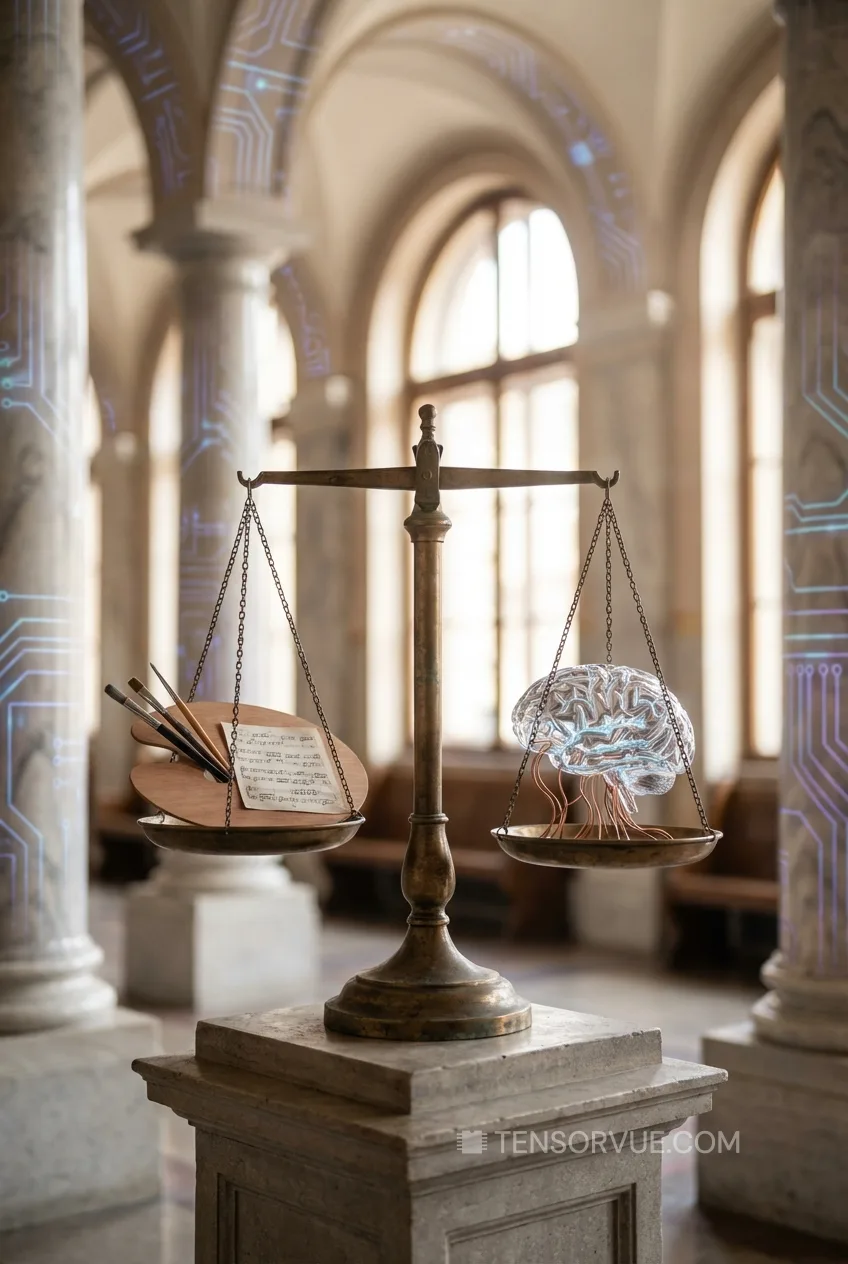
Supreme Court Refuses to Grant Copyright to AI-Generated Art as Creative Industry Lawsuits Multiply
The U.S. Supreme Court declines to hear the Thaler case, reinforcing human-only authorship for copyright, while AI copyright lawsuits doubled in 2025 and show no signs of slowing in 2026.
Source: Baker McKenzie
Key Takeaways
The Supreme Court has declined to grant copyright to AI-generated art by refusing to review Thaler v. Perlmutter, reinforcing the U.S. Copyright Office's position that copyright requires human authorship. The ruling comes as creative industry lawsuits against AI training datasets multiply.
The United States Supreme Court has declined to review the case of Thaler v. Perlmutter, effectively affirming the lower court's ruling that artificial intelligence cannot be listed as an author for copyright purposes. The decision, issued in March 2026, closes one legal avenue for AI authorship while the broader questions of AI-related copyright — particularly the legality of using copyrighted works to train AI models — remain deeply contested across dozens of active lawsuits.
The Human Authorship Standard
The Supreme Court's refusal to hear the Thaler case reinforces the U.S. Copyright Office's consistent position: only works created by human authors are eligible for copyright protection. AI-generated outputs — whether images, text, or music — cannot receive copyright protection on their own. However, works where AI serves as a tool with significant human creative direction may still qualify, creating a nuanced and largely untested middle ground.
The Training Data Battleground
The more commercially consequential battles concern the use of copyrighted material to train AI models. AI copyright lawsuits more than doubled in 2025, and the trend shows no sign of slowing. Active cases span every major creative industry:
| Case | Plaintiffs | Defendant | Key Issue |
|---|---|---|---|
| Andersen v. Stability AI | Visual artists | Stability AI, Midjourney | Training on copyrighted images (trial: April 2027) |
| Getty v. Stability AI | Getty Images | Stability AI | 12M+ copyrighted images used without license |
| Authors Guild v. OpenAI | Book authors | OpenAI, Microsoft | Books used to train GPT models |
| Concord v. Anthropic | Music publishers | Anthropic | Song lyrics in Claude training data |
| RIAA v. Suno | Major record labels | Suno | Sound recordings used for AI music generation |
| NY Times v. OpenAI | New York Times | OpenAI, Microsoft | Millions of articles used for training |
| YouTubers v. Snap | YouTube creators | Snap Inc. | Videos scraped for Imagine Lens AI |
From Lawsuits to Licensing
A notable trend emerging alongside the litigation is the growth of licensing agreements. Universal Music Group's settlement with AI music company Udio in 2025 — which included licensing deals and plans for an authorized AI music service — may represent a template for resolving these disputes commercially rather than through the courts. Several AI companies have begun proactively licensing content from publishers and media organizations, signaling an industry-wide shift toward compensated access.
The legal landscape for AI and copyright remains deeply uncertain. Courts have reached inconsistent conclusions on the applicability of fair use to AI training, and no appellate court has issued a definitive ruling on the core question of whether training an AI model on copyrighted works constitutes infringement. Clear legal standards are likely years away — but the financial stakes for both AI companies and creative industries ensure that litigation will continue to intensify in the interim.